
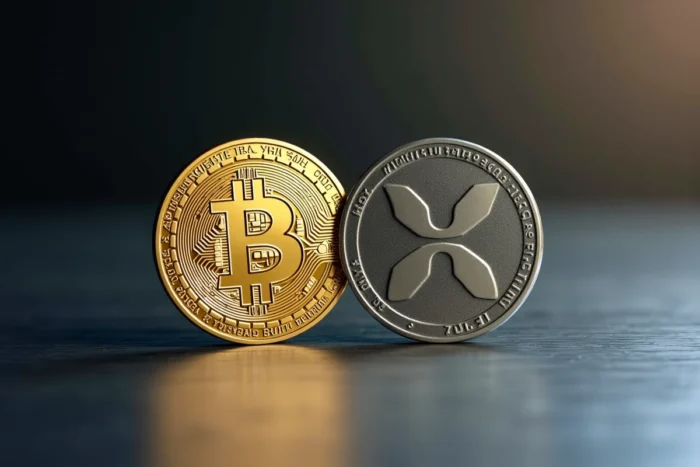
Bitcoin and XRP occupy two very different positions in the cryptocurrency market. The former concentrates the majority of the total market capitalization and attracts institutional flows through spot ETFs. The latter positions itself as a fast cross-border payment rail, with growing adoption in European structured finance. Comparing these two assets is akin to opposing two visions of the role that a cryptocurrency can play in the financial system.
XRP as a Structured Institutional Asset: An Underestimated Turning Point
Most comparisons focus on transaction speed or the consensus mechanism. They overlook a recent signal that is a game changer for XRP in the institutional space.
A physically-backed ETN based on XRP, the WisdomTree Physical XRP (ticker WXRP), was launched on November 18, 2024. This product, domiciled in Jersey with total fees of 0.50% per year, has accumulated approximately 310 million euros in assets under management and has shown a performance of over 84% since its inception. This type of regulated financial vehicle places XRP in an asset category comparable to that of Bitcoin in organized European markets.
Drawing a comparison between Ripple and Bitcoin without considering this development ignores the fact that XRP is no longer confined to a utility token role for payments. It is becoming a structured investment underlying, accessible to investors who would never buy crypto on a traditional platform.
Bitcoin has had similar products for a longer time (spot ETFs in the U.S., ETPs in Europe), giving it an advantage in terms of institutional liquidity. The question is whether XRP can close this gap as the product offering diversifies.
Payment Network vs. Store of Value: Two Distinct Markets
Bitcoin and XRP do not compete on the same ground. Confusing them in a single ranking is like comparing a gold bar to a bank transfer system.
Bitcoin functions as a digital store of value, with a capped supply of 21 million units. Its proof-of-work mechanism makes it slow and energy-intensive, but this characteristic is perceived as a security guarantee by institutional players who see it as a hedging asset.
XRP, on the other hand, was designed for the rapid settlement of cross-border transactions. Confirmations take a few seconds, compared to several minutes for Bitcoin. The total supply of XRP tokens is fixed at 100 billion units, giving it a very different economic profile.
- Bitcoin attracts investors looking for exposure to a rare and decentralized asset, often compared to digital gold
- XRP targets payment infrastructures, banks, and international money transfer corridors
- Both assets cater to different adoption logics: speculative and wealth-preserving for Bitcoin, utility and transactional for XRP
Talking about market dominance without specifying which market makes no sense. Bitcoin dominates capitalization, XRP aims for the plumbing of global payments.
SWIFT, Blockchain, and Banking Adoption: Where Does XRP Stand?
A common argument in favor of XRP is based on its potential to replace or complement the SWIFT network for cross-border payments. The available data does not allow us to conclude that this replacement is imminent.
SWIFT recently unveiled its own blockchain ledger project, tested with several major banks. This project aims to modernize interbank payments without going through a third-party token. In contrast, the Ripple network (the separate company from the XRP token) continues to sign partnerships with regional financial institutions.
The United Nations Development Programme (UNDP) has used on-chain payments (via Stellar, a direct competitor of XRP in payments) for humanitarian transfers in Haiti and Syria. This precedent shows that the adoption of blockchain payments is progressing, but not exclusively through XRP.
For investors, the question is not whether blockchain will transform international payments. It is to determine which network and which token will capture the largest share of these flows. XRP has a technological edge in this niche, but competition (Stellar, regulated stablecoins, SWIFT initiatives) is real.
The Regulatory Factor as a Catalyst or Brake
The legal framework plays a crucial role. XRP has gone through a long litigation process with the SEC in the United States, the outcome of which has partially clarified its status. In Europe, the MiCA regulation now governs crypto-assets and creates a more predictable environment for structured products like the WisdomTree ETN.
Bitcoin benefits from older regulatory clarity, particularly due to the approval of spot ETFs. This regulatory lead translates into larger capital flows and superior liquidity in organized markets.

Market Scenarios for Bitcoin and XRP in the Medium Term
Claiming that one cryptocurrency will “dominate” the other assumes a zero-sum market, which does not reflect reality. Ground-level feedback diverges on this point: some analysts see XRP gaining market share in institutional payments, while others believe stablecoins will capture this segment before it does.
- If the adoption of Bitcoin ETFs continues to grow, its position as a store of value strengthens and attracts more institutional capital
- If banks massively adopt blockchain payment rails, XRP may see its transactional use explode, but its market capitalization may not necessarily catch up to Bitcoin’s
- If regulated stablecoins (backed by the dollar or euro) become the payment standard, XRP loses its main utility argument
- A coexistence scenario remains the most likely: Bitcoin as a reserve asset, XRP as a settlement infrastructure
The market capitalization of Bitcoin currently represents a significantly larger share of the total crypto market. XRP, despite its progress, remains far behind in absolute value. This asymmetry will not correct itself in a single cycle.
The real challenge for XRP is not to dethrone Bitcoin, but to prove that its network can become a payment standard adopted by enough institutions to justify a sustainably higher valuation than its current level. For Bitcoin, the challenge is different: to maintain its status in the face of changing monetary policies and the emergence of sovereign digital competitors.