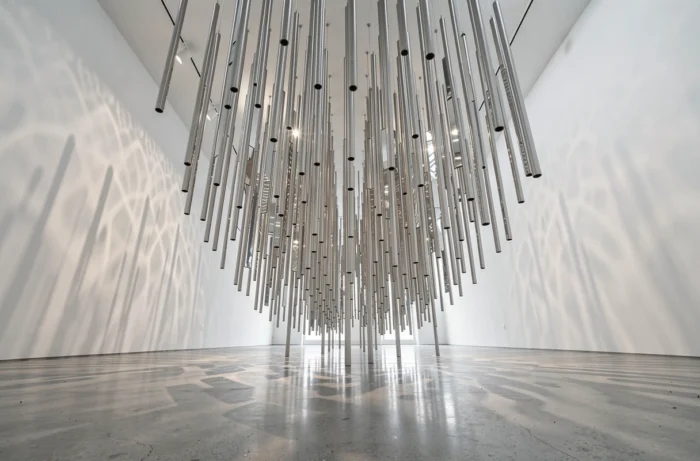
Have you ever fixed a striped pattern on a screen and felt like it was undulating? It’s not your vision that’s faltering. Your brain interprets visual cues as if they were real movement. Moving optical illusions exploit this mechanism, and kinetic art has turned it into a discipline in its own right, where the canvas, sculpture, or installation seems to breathe without any motor.
How the brain creates movement from a still image
The visual cortex constantly processes signals of brightness, contrast, and edges. When these signals are arranged in certain patterns (offset repetitions, strong contrasts between light and dark areas), the brain detects a movement that does not physically exist.
Recent work conducted at EPFL has shown that the brain “constructs” its own visual sequences by filling in the gaps between two still images. This process, called temporal interpolation, is so powerful that it can create a perception of a smooth trajectory from just a few static markers.
This is exactly what artists like Victor Vasarely have intuitively understood. By arranging squares, circles, or lines according to precise grids, they trigger in the viewer a sensation of pulsation, swelling, or rotation. The artwork does not move, but the viewer’s eye generates the movement itself.
The possibility to explore moving optical illusions allows for a better understanding of this perceptual mechanism, where geometry becomes a tool for gentle manipulation of the gaze.
Optical art and kinetic art: two approaches to perceived movement
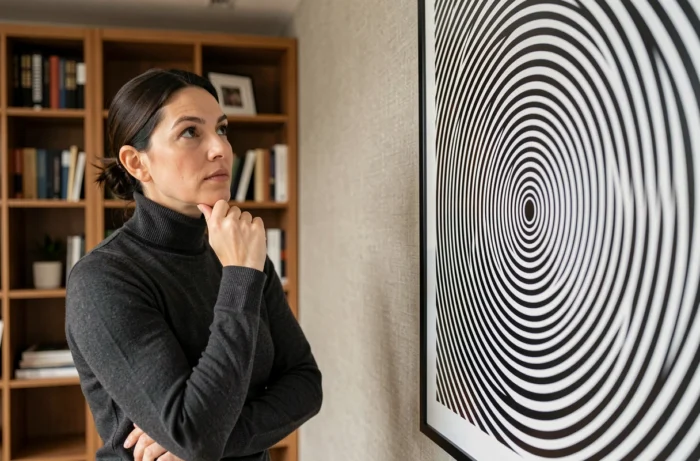
These two movements are often confused, and the boundary is thin. Optical art (op art) uses only painted or printed patterns to provoke an illusion of movement. Kinetic art, on the other hand, sometimes incorporates real physical movement (motor, wind, visitor interaction).
What distinguishes them concretely
- Op art relies on contrast and geometric repetition. A canvas by Bridget Riley, for example, seems to vibrate while being perfectly flat and still.
- Kinetic art in the strict sense includes moving sculptures, motorized installations, or devices activated by the viewer, such as the reliefs of Jesús Rafael Soto where the visitor walks through suspended rods.
- A third hybrid movement mixes the two: fixed structures whose appearance changes depending on the viewer’s angle. Simply walking in front of the artwork is enough to transform the perceived pattern.
Victor Vasarely, often presented as the father of optical art, explored these registers in his monumental compositions. The Vasarely Foundation in Aix-en-Provence preserves his architectural integrations, where each wall becomes an active perceptual surface.
Illusions of movement and depth perception: an issue beyond art
These phenomena are not confined to museums. A research program conducted by the CSIC Institute of Optics in Spain has highlighted that people suffering from presbyopia perceive the distance of moving objects incorrectly. The illusion of depth movement exists in everyone, but it becomes significantly more pronounced in people whose vision is fatigued.
Researchers have validated a portable device capable of measuring this illusion individually. The goal: to adapt optical correction to each person’s sensitivity to illusions of movement. This is no longer just a fun effect; it’s a parameter of road safety and daily visual comfort.
This applied dimension shows that understanding illusions of movement has implications far beyond aesthetics.
Augmented reality in kinetic art exhibitions: the visitor triggers the illusion
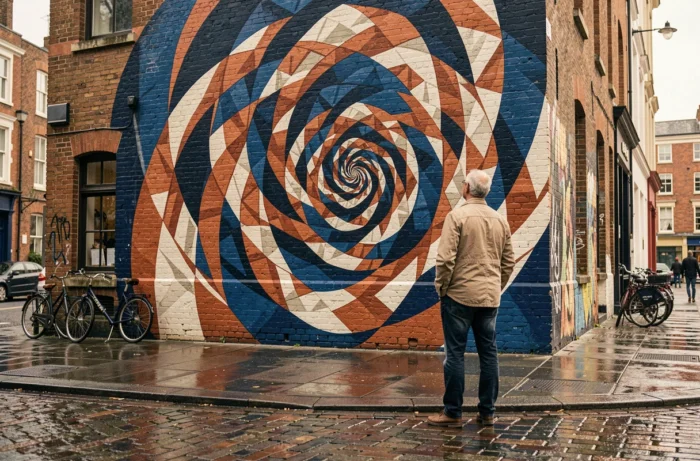
In recent years, illusion museums have integrated layers of augmented reality into their exhibits. The Illusion Art Museum in Prague offers installations where the visitor makes animations and virtual extensions of certain works appear through their smartphone. One can “paint with light” in interactive devices or see a fixed sculpture start to spin on their phone screen.
The viewer no longer just experiences the illusion; they provoke it. This shift changes the very nature of the experience. In a traditional exhibit, the effect relies on spatial arrangement and viewpoint. With augmented reality, each visitor gets a slightly different version of the artwork based on their gestures and movements.
What this changes for creation
For artists, augmented reality opens a new technical field. A kinetic artwork can now exist in two layers: the physical structure visible to the naked eye and a digital layer that extends the perceived movement. Google Arts & Culture, for example, has used generated animations to enrich painting exhibitions, transforming static canvases into animated sequences.
This hybridization also raises questions. When the illusion is produced by an algorithm on a screen, does it remain of the same order as that provoked by an arrangement of painted shapes? The answer depends on what one expects from an optical illusion: a spontaneous perceptual phenomenon or a programmed spectacle.
Three tips for appreciating kinetic art in exhibitions
Have you ever visited an optical art exhibition without quite knowing what to look at? A few simple tips can change the experience.
- Vary your distance from the artwork. Most illusions of movement change radically between one meter and five meters. Step back, move forward, and observe how the pattern transforms.
- Move laterally. Kinetic works with reliefs or overlapping grids produce different effects depending on the angle. Sometimes, a step to the side is enough to shift perception.
- Stay in front of a piece for at least a minute. Illusions of movement strengthen with fixation time. The first few seconds show a pattern, while the following ones reveal the latent movement.
Major retrospectives dedicated to Vasarely, immersive exhibitions inspired by Escher, or interactive paths like the one in Prague share a common point: the artwork only fully reveals itself to a viewer who is willing to move. Kinetic art is the only artistic movement where standing still in front of a canvas means missing out on half of the work.