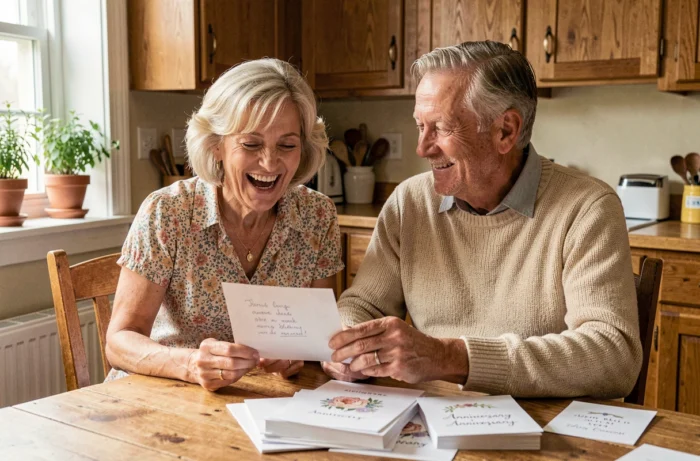
The ruby wedding anniversary marks forty years of shared life. Writing a funny message for this occasion requires mastering a precise balance: the joke should elicit a smile without offending the couple or embarrassing the other guests who will read the card. The tone that works best for this type of card is gentle humor followed by a mark of affection, not a dry, isolated joke.
Group card or individual card: adapting the humorous tone
The first question to settle before writing is not “which joke to choose,” but “who will read this card.” A card signed by one person allows for private references, shared memories, and a conspiratorial tone. A collective card, signed by ten or fifteen guests, imposes different constraints.
On a card with multiple signers, an inside joke loses its effect if it requires an explanation. The cousin who doesn’t know the story of the failed trip to Brittany will remain perplexed. Worse, he might interpret the comment as a jab. Recent writing advice emphasizes this point: in a group card, the humor must be understandable to all readers without additional context.
In practice, this leads to two distinct approaches. For an individual card, the text can rely on a shared memory. For a collective card, it’s better to aim for a universal observation about couple life that everyone will recognize.
If you’re looking for humorous texts for 40 years of marriage ready to use, you will find templates tailored to these two scenarios.
Structure of a humorous text for 40 years of marriage that works
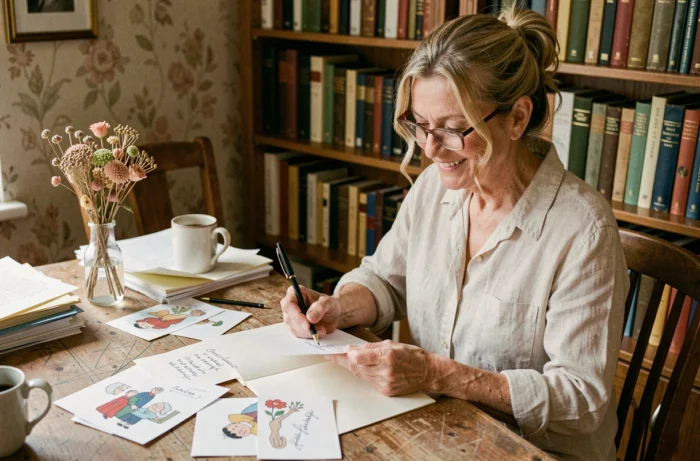
A successful funny message for a wedding anniversary is based on a simple mechanism: a punchline followed by a sincere return to affection. The joke alone, without a tender landing, sounds off on a ruby wedding card. The couple is celebrating four decades of mutual patience, and the message must reflect this reality.
The punchline then tenderness scheme
The text starts with an exaggerated or offbeat observation about the length of the marriage, then shifts to an authentic compliment. This format works because it replicates the real dynamic of a lasting couple: we tease each other, then we remember why we stay together.
- Exaggerated observation about daily life (snoring, remote control, selective memory) that remains light and universal
- Transition to a positive statement about the couple’s strength, phrased without grandiosity
- Short, warm signature that closes the message on a note of direct affection
Examples of suitable formulations
“Forty years sharing the same bathroom, the same fridge, and the same debates over the thermostat. Honestly, if that’s not love, no one knows what it is. Happy anniversary!”
“Forty years of marriage is like a good cheese: it gains character over time, and not everyone has the palate to appreciate it. Congratulations to both of you.”
“You’ve survived renovations, family vacations, and Christmas dinners. After forty years, nothing can stop you now. With all my admiration.”
Each example follows the same pattern: a comparison of daily life, not a mockery of the individuals. The target of the joke is the situation, never one of the spouses.
Humorous text for a wedding card: pitfalls to avoid
The humorous tone has risk areas that ready-to-print card catalogs do not always highlight. Poorly calibrated humor on a wedding anniversary card can turn a good moment into discomfort.
Do not send a joke when the emotional context is tense
If the couple is going through a difficult time (recent bereavement, health issues, visible family tension), a humorous message becomes inappropriate even if it is well-meaning. Recent etiquette guides phrase this rule simply: adapt the tone to the moment, not just to the occasion.
Avoid unbalanced gendered humor
Card catalogs increasingly segment their models by recipient (for wife, for husband, for in-laws). This segmentation has an advantage: it allows for personalizing the connection. It also has a frequent drawback: “for husband” jokes often fall into the cliché of the lazy spouse, and “for wife” ones into that of the bossy partner.
On a card read publicly during a festive meal, these stereotypes age poorly. It’s better to aim for observations about the couple as a team, rather than remarks that pit the two partners against each other.
- Avoid jokes about physical appearance, weight, or aging of just one spouse
- Prefer shared experiences (trips, household habits, differing tastes in TV shows)
- Reread the text imagining it is read aloud in front of thirty people: if it provokes an awkward laugh, rephrase it
Personalizing a message of wishes for 40 years without falling into the generic
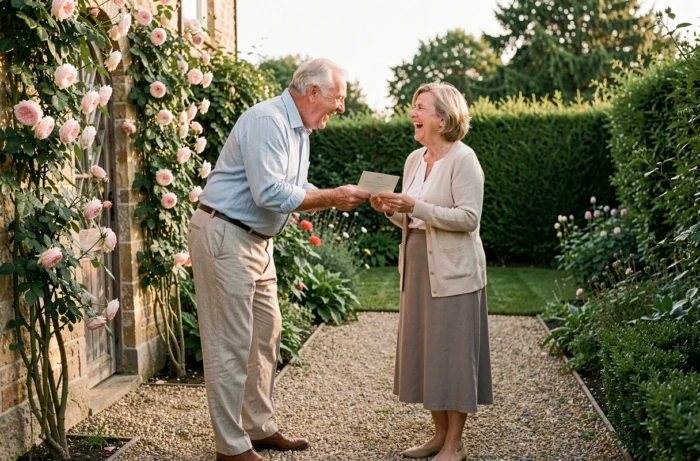
Text templates are a starting point, not a finished product. A message that begins with “Happy anniversary” followed by a quote copied from a website is something the couple has already read three times in other cards. The personal detail transforms a template into a keepsake.
The most effective method is to replace a single generic element of the template with a real fact. Instead of “forty years sharing the same house,” writing “forty years sharing the house on Lilac Street” changes the entire message. The couple recognizes themselves, and the card stands out.
If no specific memory comes to mind, an observation about a trait of the couple is enough: their favorite dish, their recurring vacation destination, their Sunday morning routine. The humorous text for ruby weddings gains strength each time it proves that the author truly knows the recipients, not just their number of years of marriage.
The best card text is not the funniest. It’s the one that the couple will reread in six months with a smile because it says something true about them.