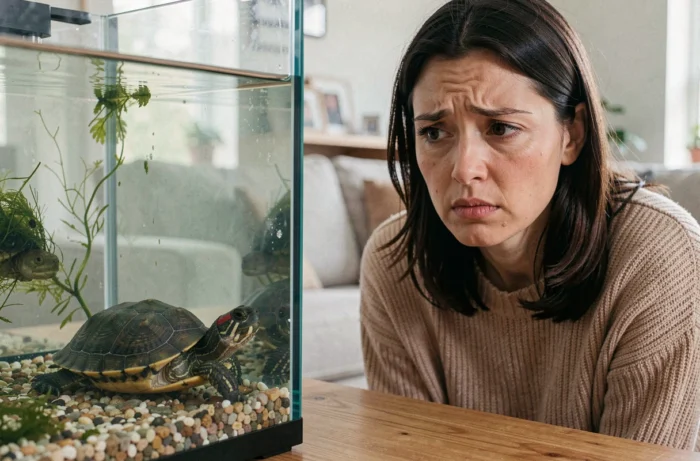
An immobile water turtle at the bottom of the aquarium does not necessarily indicate death. The challenge lies in distinguishing between a state of deep brumation, pathological lethargy, and actual death. Here, we detail reliable protocols to make the determination, emphasizing tests that are rarely described in mainstream guides.
Clocal reflex and neurological response: the lesser-known tests
The withdrawal reflex of the hind limb remains the most discriminating field test. By gently pinching the skin between the tail and the hind leg (pericloacal area), a living turtle, even in deep brumation, will contract the limb or retract the tail. The complete absence of cloacal reflex after repeated stimulation strongly indicates death.
A second test involves applying light pressure to the lower eyelid or gently touching the cornea with a damp cotton swab. The blink reflex persists in an animal in brumation. In a deceased specimen, the eye remains fixed, with a dilated pupil, showing no contraction.
We recommend combining these two tests rather than relying on a single criterion. The signs indicating the death of a turtle are never limited to immobility or floating, both of which can occur in a living but weakened animal.
Immobile water turtle: differentiating brumation and death
When the water temperature drops below the brumation threshold, metabolism decreases to an almost undetectable level. Breathing may reduce to one inhalation every several minutes. This extremely low frequency often deceives owners.
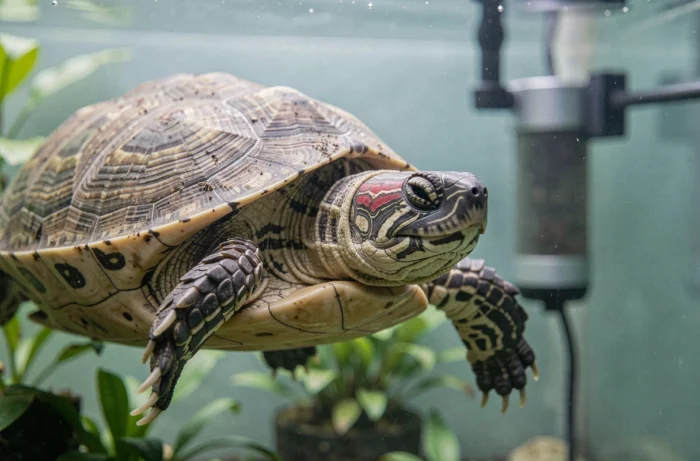
To assess breathing, we place a small mirror or a cold, smooth surface in front of the nostrils. Any condensation confirms respiratory activity. This test requires a calm environment and several minutes of patience.
Body temperature alone cannot determine the outcome. A poikilothermic reptile in brumation presents a body temperature aligned with its environment, just like a deceased specimen. This criterion, often mentioned in forums, is therefore insufficient without the reflex tests described above.
Surface floating in the aquarium
A water turtle that persistently floats, belly up, without attempting to right itself, presents a very unfavorable sign. This position often indicates a post-mortem gas buildup in the coelomic cavity. Caution: some respiratory pathologies also cause abnormal floating in a living but seriously ill animal.
Asymmetrical floating with lateral tilt suggests unilateral pneumonia rather than death. In this case, checking the response to tactile stimuli remains the only way to clarify the situation.
Post-mortem visual signs in aquatic turtles
Cadaveric rigidity (rigor mortis) sets in among reptiles within hours following death, but its duration and intensity vary significantly with ambient temperature. In cold water, the process is slow and may be confused with muscle stiffness in an animal experiencing severe hypothermia.
Reliable visual signs appear later:
- A marked sinking of the eyeballs into the orbits, resulting from tissue dehydration.
- A change in skin coloration around the neck and limbs, turning grayish or greenish depending on the species.
- A complete relaxation of the jaw with the tongue visible, sometimes darkened.
These changes do not appear immediately. In the first hours following death, the appearance may remain strictly normal, which reinforces the usefulness of reflex tests over passive observation.
Odor as a late indicator
The decomposition of tissues in an aquatic environment quickly produces a characteristic, sulfurous, and acrid odor. In an aquarium, this odor is usually detected by lifting the turtle out of the water. If the animal emits a putrid smell, death is confirmed and no longer in doubt. However, the absence of odor does not allow for a conclusion about survival.
Veterinary confirmation and necropsy in exotic pets
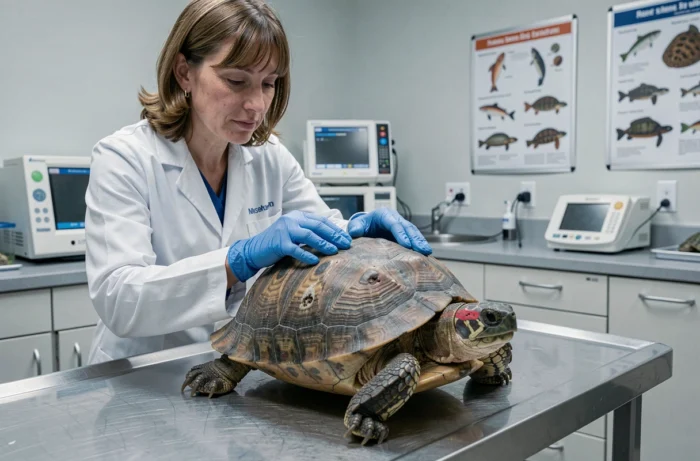
In the face of persistent doubt, consulting a veterinarian specialized in exotic pets (NAC) is the only step that removes any ambiguity. The professional clinical examination includes:
- Cardiac auscultation using a pediatric stethoscope or a Doppler probe, the only tool capable of detecting extremely weak beats.
- Assessment of deep neurological reflexes (withdrawal, corneal, cloacal) under standardized conditions.
- Verification of the absence of residual muscle tone in the limbs and tail.
When death is confirmed, necropsy allows for identifying the cause of death and ruling out an environmental or infectious problem that could affect other animals in the same aquarium. NAC clinics offer this examination, which provides information on possible nutritional deficiencies, bacterial or parasitic infections.
Water quality and upstream prevention
A sudden death often points to a maintenance issue in the aquarium. A spike in ammonia or nitrites, an inappropriate temperature for the species, or the absence of a dry area for thermoregulation: these factors remain the primary causes of mortality in domestic water turtles. After a death, we recommend a complete check of water parameters before reintroducing another animal.
The death of a water turtle is confirmed by a convergence of criteria, never by a single sign. The pericloacal and blink reflex tests, combined with the observation of breathing and post-mortem changes, form the foundation of a reliable diagnosis before any veterinary intervention.