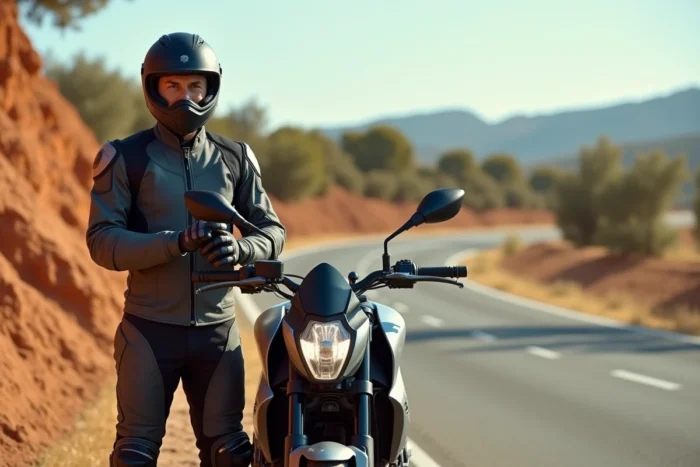
We are preparing for a motorcycle road trip to Barcelona or Andalusia, loading the saddlebags, checking the tire pressure, and the question arises at the last moment: what equipment is actually required once the border is crossed? Spanish legislation does not work exactly like the French one, and some differences can be costly on the side of a Catalan national road.
Road checks in Spain: what changes compared to France
In France, we have gotten used to mandatory CE-approved gloves since 2016. In Spain, at the time of writing, gloves are not yet legally required, although the DGT (Dirección General de Tráfico) has announced plans to impose them in the near future. Feedback on this point varies according to sources, as the precise implementation schedule has not been officially confirmed.
What does not change: the helmet remains the key piece. Wearing a helmet is mandatory for the driver and all passengers, including on mopeds. Not wearing a helmet can result in a fine of around 200 euros and a loss of 4 points on the Spanish driving license. For holders of a French license, the financial penalty applies directly on the spot.
To better understand each clothing obligation before leaving, one can refer to the details on the mandatory motorcycle equipment in Spain according to Voyage Blog, which summarizes the current requirements and announced developments.
Another point not to be overlooked: riding someone else’s motorcycle in Spain requires written permission from the owner. This is not just a recommendation; it is a legal obligation. Guardia Civil officers can request it during a check.
Full-face or jet helmet in Spain: a choice that may disappear
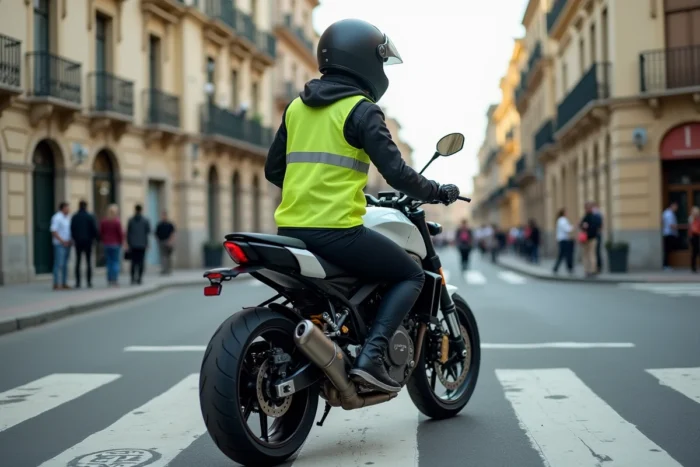
The DGT presented a set of measures in 2024 following a notable increase in motorcycle fatalities in 2023 (45 additional deaths compared to the previous year, for a total of 286 motorcycle fatalities). Among these measures is a proposed ban on jet helmets in favor of approved full-face or modular helmets.
The precise timeline has not yet been established, but the direction is clear. For a French motorcyclist crossing the border with a jet helmet, the regulatory risk is emerging in the medium term. Specifically, it is recommended to travel with a full-face or modular helmet, if only as a precaution.
Helmet approval: the standard to check
Spain requires a helmet approved according to European regulations (ECE marking). A helmet sold in France with this approval is therefore valid on the other side of the Pyrenees. There is no need to buy a specific helmet, but be careful with old models whose approval label may be worn off or missing: this is what officers check first.
Required documents and safety equipment on the motorcycle
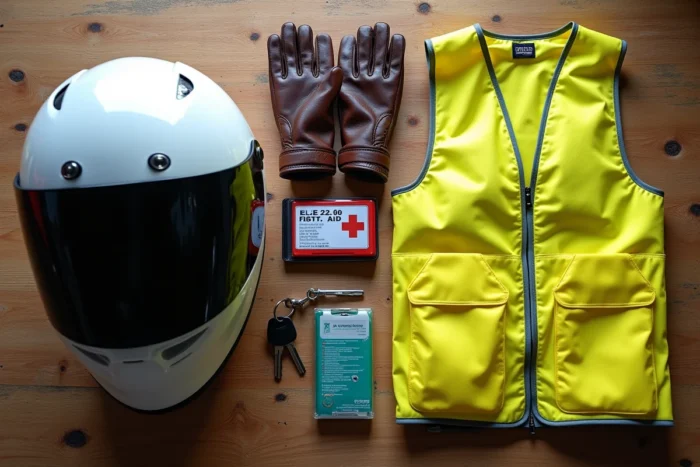
Beyond the rider’s outfit, the motorcycle itself must carry certain items. Here is what you must have on you or on the machine during a trip in Spain:
- Valid driving license and vehicle registration (originals, not copies)
- Valid identity card or passport for each person on board
- The green insurance card, highly recommended even though it is no longer technically mandatory between EU countries (it speeds up procedures in case of a check or accident)
- A high-visibility vest within reach, to be worn in case of an emergency stop outside built-up areas
The reflective vest must be accessible without opening a locked top case. In practice, it is slipped under the seat or in a side pocket. The idea is to be able to put it on before even getting off the motorcycle on a fast lane.
Low beam lights on at all times
Spain requires low beam lights to be on during the day and night for motorcycles. Most recent motorcycles activate them automatically upon starting, but on an older model, you need to remember to turn them on manually. The fine for lights being off remains moderate, but it is an additional reason for a check.
Emergency stop lane and lane splitting: specific rules for two-wheelers
One Spanish particularity deserves attention. The DGT has approved a measure allowing motorized two-wheelers to use the emergency stop lane in case of traffic jams, with implementation expected in 2025. The conditions are strict:
- Maximum speed of 30 km/h on the emergency stop lane
- Absolute priority for emergency vehicles (ambulances, police, tow trucks) and cyclists
- Reintegration into the normal lane as soon as traffic becomes fluid again
This rule does not exist in France. A French motorcyclist used to Parisian lane splitting should not confuse the two systems. In Spain, filtering between lanes is not regulated in the same way, and tolerated practices vary by autonomous communities.
Alcohol at the handlebars and penalties in Spain: the thresholds to know
The maximum blood alcohol level allowed for motorcyclists in Spain is the same as for drivers. For experienced drivers, the threshold is set at 0.5 g/l of blood. For young drivers (less than two years of license), the threshold drops to 0.3 g/l.
Alcohol checks are frequent on tourist routes, particularly on weekends and during the summer period on the Mediterranean coast. Refusing a test constitutes a serious offense, treated as a criminal offense.
Motorcycle legislation in Spain is evolving rapidly, driven by a clear intention to reduce two-wheeler accidents. Before each departure, a quick check of the current rules avoids unpleasant surprises. A full-face helmet, up-to-date documents, and knowledge of local specifics (emergency stop lane, lights on, accessible vest) form the foundation for a smooth journey on the other side of the Pyrenees.