
A child comes home with unexplained bruises, another accumulates absences without anyone reacting, a teacher makes repeated degrading remarks. In the face of these situations, we often hesitate about the course of action to take. Reporting a problem in a school requires knowing who to contact, in what order, and with what concrete elements to ensure the process is effective.
Written records and evidence: prepare your report before taking any action
Before contacting anyone, it is advisable to gather factual elements. A report without written records remains a word against another. The head of the institution, the academic inspection, or the prosecutor will handle the case more quickly if it is based on dated and documented facts.
Specifically, note each incident in a notebook or file: date, time, location, people present, brief description of the facts. If the child reports remarks, transcribe them word for word, in quotation marks, with the context. Screenshots of messages or posts on social media can usefully complement the file, especially in cases of cyberbullying.
A dated and factual file accelerates every step of the reporting process. Without these elements, institutional interlocutors may classify the request or refer it to another service. Emotional formulations in letters should also be avoided: facts speak louder than value judgments.
Knowing how to report a school also involves understanding what the institution itself is required to do when it identifies a problem, and the obligations that weigh on its staff.
Reporting a school danger: the interlocutors in the right order
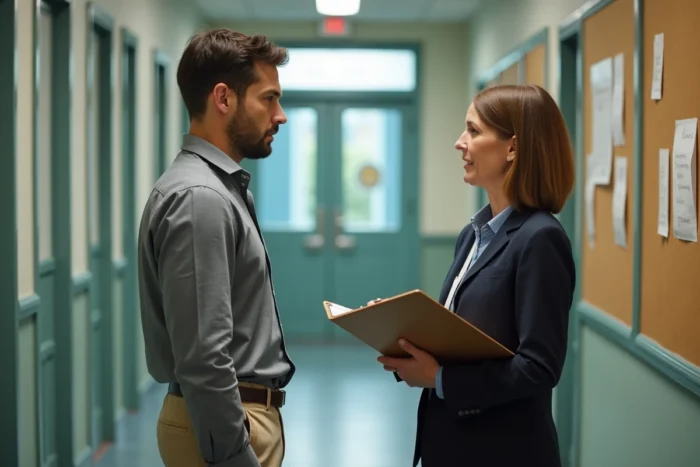
Sometimes it is believed that one must write directly to the rectorate or the prosecutor. In most cases, the first step goes through the institution itself. The main teacher, the principal education advisor, or the school director are the first logical recipients of a report.
The head of the institution as the first point of contact
The school director (in primary) or the head of the institution (in middle and high school) has a duty to protect students. When a problem is reported to them in writing, they are required to respond and, depending on the severity, to forward a worrying piece of information to the departmental services or a report to the public prosecutor.
If the response is delayed or if the problem directly concerns the management, one moves up to the next level. Responses vary on this point: some families receive a reaction within a few days, while others wait several weeks without news.
The academic inspection and the rectorate
The inspector of national education (for the first degree) or the academic director of national education services (DASEN) handle reports that the institution has not resolved. A registered letter with acknowledgment of receipt is sent to them, along with the gathered evidence and a copy of the first letter sent to the head of the institution.
The registered letter with acknowledgment of receipt creates an opposable record that prevents the administration from claiming it was not informed. A copy of each sending should always be kept.
Worrying information or judicial report: distinguishing the two pathways
The confusion between these two mechanisms is common. They are triggered in different situations, and mixing them up can slow down the response.
- Worrying information concerns a child whose health, safety, morality, or educational conditions are compromised. It is transmitted to the worrying information collection unit (CRIP) of the department, which assesses the situation and may propose social support.
- The judicial report is addressed to the public prosecutor when a child is in serious and immediate danger, or when criminal acts are suspected (violence, assaults, abuse). Any citizen can make this report, not just professionals.
- In case of doubt about which path to take, the national number 119 (Child in Danger) guides to the appropriate mechanism and can make a referral to the competent authorities.
An automatic alert system is to be deployed by the start of the 2026 school year to more quickly cross-reference weak signals (absences, school dropout, social alerts) and trigger faster reports to the competent authorities. This digital system aims to bridge communication gaps between institutions, social services, and justice.

Obligations of school staff in the face of a report
Teachers and school life staff do not choose whether to report or not. Article 434-3 of the Penal Code punishes the failure to inform the authorities of a situation of mistreatment or deprivation inflicted on a minor. The silence of an education professional is a criminal offense.
In practice, institutions are now more frequently seized, parents are increasingly seeking external authorities, and internal procedures for handling reports are much more often mobilized. This evolution pushes academies to formalize written protocols, designating referents in charge of monitoring reported situations.
The report on the academic success of entrusted children emphasizes the designation of professionals specifically responsible for schooling, so that concerns identified at school (absenteeism, signs of distress, violence) are better relayed and produce more coherent reports.
Recourse if the report goes unanswered
An ignored report does not mean that one has exhausted their options. Several channels exist beyond the National Education:
- The Defender of Rights can be contacted free of charge by any parent or person witnessing a dysfunction in a public or private school under contract.
- The mediator of National Education and higher education handles disputes between families and school administration. If the report does not fall under its jurisdiction, it can forward it to the competent external body.
- In case of serious danger, the public prosecutor can be contacted directly, without going through the school administration.
Each recourse must be accompanied by the file constituted from the start. The letters sent, acknowledgments of receipt, and any responses from the institution form a history that each new interlocutor can utilize.
When a school report leads to a judicial protection measure, the child benefits from an enhanced framework to express their voice and contest or clarify the facts reported by the institution. This guarantee exists to prevent a poorly calibrated report from producing disproportionate effects on the family. Keeping a copy of each exchange, at every stage, remains the best protection for all parties.