The height of a photobooth directly affects the quality of the photos taken at a wedding. If it’s too low, the lens distorts faces from a low angle. If it’s too high, shorter guests or those in wheelchairs end up out of frame. This parameter may seem trivial, but it determines the shooting angle, the proportion of silhouettes, and the final rendering on each print.
Mirror photobooth, classic booth, or XXL structure: compared heights
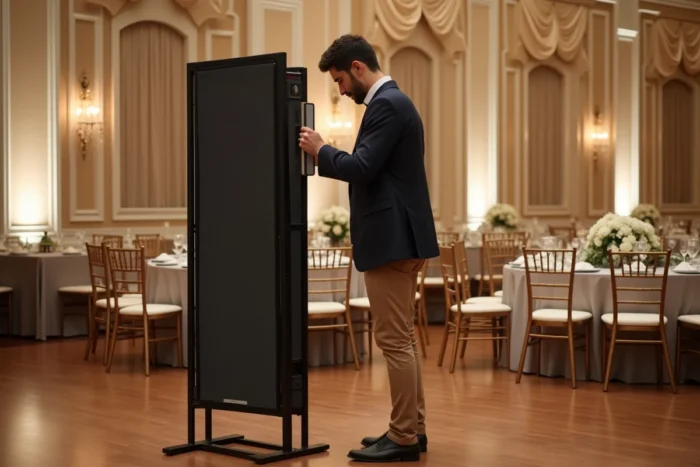
Not all photobooth formats impose the same vertical positioning constraints. Full-length mirror booths, increasingly popular in recent years, feature a reflective surface that accommodates a standing adult. Their total height often exceeds that of a classic telescopic booth.
| Type of photobooth | Typical lens height | Main target audience | Risk of distortion |
|---|---|---|---|
| Classic telescopic booth | Adjustable (bust to face) | Standing adults, groups | Low if well adjusted |
| Full-length mirror photobooth | Fixed, height of a full-length mirror | Adults, couples, solo | Shortened silhouettes in large groups |
| XXL structure / monumental frame | Very variable depending on the structure | Large groups, staged photos | Crushed perspective if lens is too high |
| Low booth or adapted for PRM | Lower than average | Children, wheelchair users | Low angle on tall adults |
French photobooth rental companies now offer height-adjustable booths (telescopic leg or adjustable column) to meet accessibility requirements, particularly for guests in wheelchairs and children. This point, long overlooked, is part of the criteria to check upon booking, as highlighted by several tips on Blog Mariage dedicated to the topic.
Shooting angle and perspective distortion: what height really changes
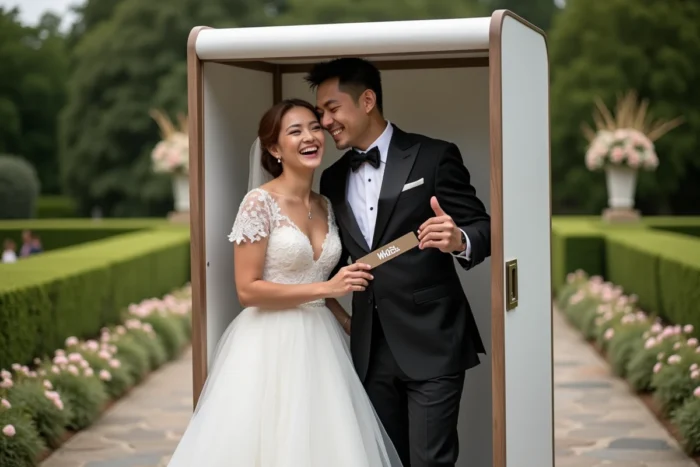
A lens positioned at bust height captures faces with natural proportions. If mounted too high, it accentuates the forehead size and shrinks the chin. If placed too low, it widens the jaw and shortens the nose.
In a group photo (four to eight people side by side), the effect accumulates. Guests at the edges of the frame experience a barrel distortion that wide-angle lenses of booths amplify. The further the lens is from the average eye level of the group, the more visible the distortion.
XXL structures and monumental frames pose a specific problem. Their lens, often fixed high to frame the entire decorative structure, creates a slight downward angle. The silhouettes then appear squashed, a flaw particularly noticeable in paper prints in strip format (like classic photo booths).
The eye level rule
The basic photographic principle remains simple: the lens must be at the subject’s eye level. For a mixed group of adults and children, the compromise lies between the eye level of a standing child and that of an average adult. A telescopic booth set slightly below the average eye level of an adult provides a slight upward angle that elongates faces without flattening the shorter ones.
Aesthetic coherence of the photobooth with the wedding’s artistic direction
High-end reception venues and some wedding fairs now incorporate the height of the photobooth into the overall scenography reflection. The goal is not just technical: it’s about visually aligning the booth with other vertical elements in the room (floral arch, buffet, photocall, decorative wall).
A photobooth whose top significantly exceeds the ceremony arch or flower wall creates a line break in the ambiance photos taken by the professional photographer. The height of the photobooth must integrate into the lines of the decoration, not break them.
- Check the ceiling height of the reception venue before choosing a booth format, especially for XXL structures or monumental frames that require significant vertical clearance.
- Align the top of the booth with the high line of the photocall or decorative background to maintain coherence in overall photos.
- Ensure there is clear space around the booth so that the integrated lighting does not cast shadows on adjacent wall or floral decor.
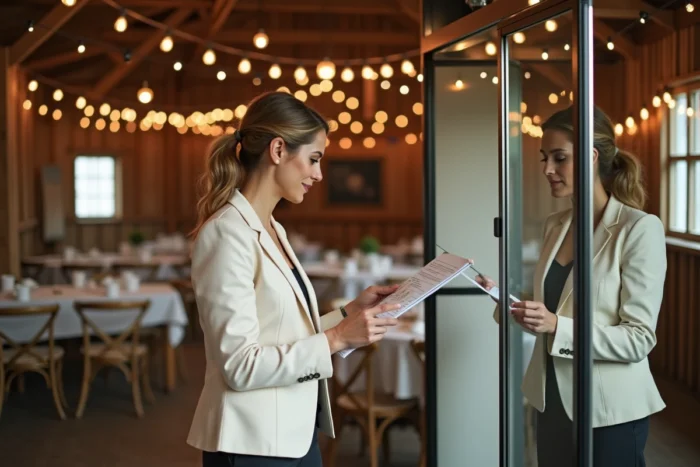
Photobooth accessibility: children, people with reduced mobility, and guests of all sizes
The trend towards accessibility in wedding entertainment has accelerated in recent years. Providers offering a telescopic leg or adjustable column allow for height adjustments between guests. A guest in a wheelchair does not have the same line of sight as a tall standing adult.
A fixed booth at a single height mechanically excludes some guests. Children, often the most enthusiastic in front of a photobooth, end up framed at torso level if the booth is calibrated for adults. The result: prints where foreheads are cut off or gazes are lost upwards.
- Ask the provider if the booth is adjustable and how long the adjustment takes (some require a tool, others can be modified in seconds).
- Plan a dedicated time for children at the beginning of the evening, with the booth set lower, before raising it for adults.
- Check that the touchscreen of the booth remains accessible from a wheelchair (trigger button, preview screen).
Choosing a photobooth for a wedding goes beyond the design of the booth or the accessories offered. The height of the lens determines the quality of each photo, the participation of all guests, and the visual harmony with the reception venue. A precise exchange with the provider on this technical point, before signing the rental contract, avoids unpleasant surprises on the big day.