The growth of online fashion in Europe has fallen to 3% according to an NIQ report, compared to 5% for global e-commerce.
This slowdown reflects a shift in purchases towards resale platforms and short supply chains, particularly among 18-29 year-olds. Fashion trends are no longer just about a color palette or a style of pants: they now encompass the origin, sustainability, and method of acquisition of pieces.
Traceable materials and upcycling: the new style marker
Upcycling and made in France have seen double-digit growth for several seasons, driven by buyers willing to pay 20 to 30% more for responsible production. The traceability of materials has become a style criterion in its own right.
Displaying an upcycled piece or a locally made garment sends a fashion signal today as clear as a trendy cut. It is no longer a militant gesture reserved for a niche: it is a code found on resale platforms as well as in the capsule collections of French brands. To keep track of these developments over the seasons, the Clarivox site dedicated to fashion offers regular analyses on these topics.
Field reports diverge on one point: the actual quality of upcycled pieces varies greatly by brand. A jacket reworked from fabric scraps can rival new items, or prove fragile if the craftsmanship is sloppy. The label or transparency of the manufacturing process remains the best indicator.
Baggy pants and loose volumes: how wide cuts are changing this season
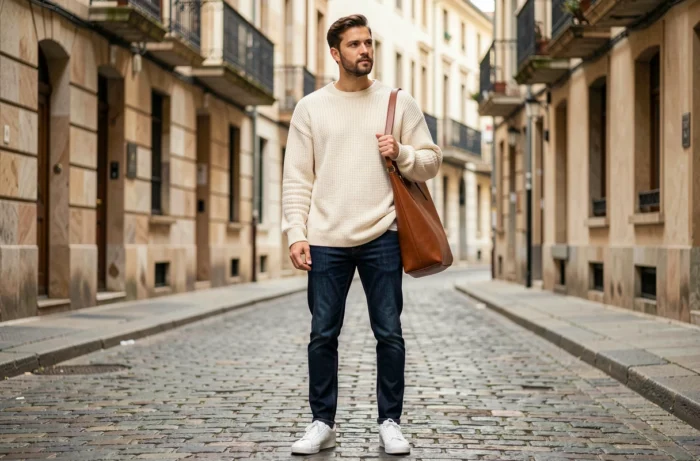
The baggy cut dominates searches related to ready-to-wear this year. Demand extends beyond the streetwear segment to daily wardrobes.
The massive adoption of loose volumes alters the balance of silhouettes. A wide pant requires rethinking the top: proportions work better with a fitted top or crop top than with an oversized shirt that drowns the silhouette. It’s a matter of proportions, not just trend.
- Baggy pants in thick fabric hold their shape better than a model in thin fabric, which tends to sag throughout the day
- Neutral colors (beige, ecru, light gray) remain the most versatile for integrating this cut into an existing wardrobe
- In a high-waisted version, the baggy visually elongates the leg, which compensates for the volume effect at the thighs
The available data does not allow us to conclude whether this trend will survive beyond the season. However, wide cuts cyclically return every ten to fifteen years, suggesting that pieces purchased today may be reused.
Second hand and resale platforms: a fashion reflex among those under 30
The NIQ report on fashion e-commerce in Europe highlights that resale has become a structural driver of the market, not a parallel segment. Among 18-29 year-olds, the buying reflex first goes through Vinted or similar platforms before turning to new items.
This behavior redefines what it means to “adopt a trend.” Instead of buying a new piece each season, a growing portion of consumers seeks the vintage or second-hand item that matches the current silhouette. A trench coat from the 2000s or a pre-owned barrel jean can embody the trend just as well as a factory-made model.
The seasonal style is now built as much on the purchasing circuit as on the garment itself. Wearing a thrifted dress from a resale platform or a jacket from a local upcycling workshop tells something more than just the cut or color.
Autumn colors and floral prints: visual codes that persist
The season’s palettes revolve around warm shades (terracotta, butter, rust) and more muted tones as autumn approaches. Floral prints, omnipresent in spring, migrate towards darker and denser versions for winter, with black or burgundy backgrounds.
One observation stands out: colors are becoming a stronger differentiation tool than cut. Two identical silhouettes in baggy and fitted top convey very different messages depending on whether they are in monochrome beige or contrasting floral print. The chromatic choice takes precedence over the form.
- Butter yellow, very present in spring, is also worn as an accessory (bag, scarf) to extend the trend without total commitment
- Provençal patterns and “tapestry” florals mark a return of vintage inspirations, consistent with the rise of second hand
- Burgundy and forest green emerge as the safe bets for the autumn-winter transition, with high combination potential
Pairing prints and solid pieces
A common pitfall is to accumulate patterns. A single strong print per outfit, combined with solid pieces in a shade present in the print, produces a more readable result. This rule works equally well with a new look as with mismatched second-hand pieces.
The upcoming season confirms a fundamental shift. Fashion trends are no longer limited to runways or lookbooks: they are also created in sourcing choices, resale circuits, and material arbitrations. A refined style in 2026 combines a mastered silhouette, intentionally chosen colors, and a clear awareness of the origin of the worn pieces.