
A package shipped from Leipzig arrives in Barcelona in two working days, while another, posted from Lyon to Marseille, stagnates on a sorting platform without any tracking updates for four days. This discrepancy is far from trivial: during a strike at DHL France, domestic and international shipments do not experience the same disruptions at all. We take stock of the concrete mechanisms that explain these differences.
DHL Strike and Heavy Goods Vehicles: The Road Constraint That Tracking Doesn’t Show
Competitors focus on the operation of sorting hubs, but an aggravating factor often goes unnoticed: the traffic bans for heavy goods vehicles in metropolitan France. The summer 2026 decree prohibits the circulation of freight trucks between 7 AM and 7 PM on certain Saturdays, in addition to the usual ban from Saturday 10 PM to Sunday 10 PM.
Under normal circumstances, DHL absorbs this constraint by adjusting its rotations. When a strike simultaneously reduces staff at sorting platforms, the remaining traffic windows are no longer sufficient to clear the accumulated volume of domestic packages.
To understand DHL delivery times during the strike, one must factor in this dual pressure: less staff for sorting, fewer road slots for transport. The result is a congestion that affects almost exclusively national flows.
International Express shipments, on the other hand, transit by air for most of the journey. Only the last mile in France depends on the road network. A package coming from Germany or Spain thus escapes most of the blockage.
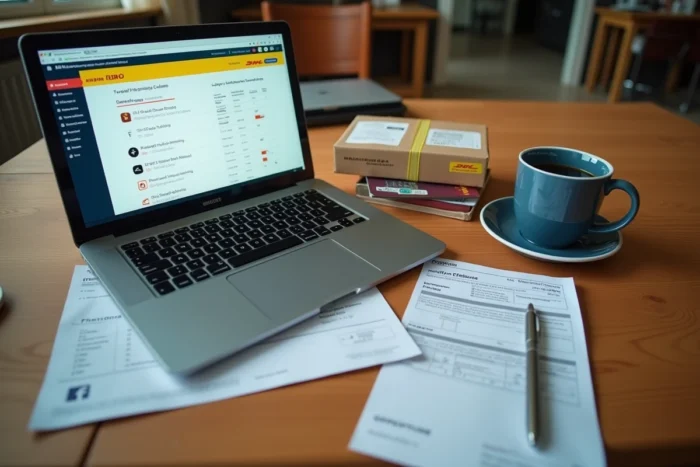
International Express Delivery vs. Standard Domestic Package: The Invisible Queue
When staff are lacking at a French DHL hub, international Express shipments take priority. This is an operational logic, not an arbitrary choice: these packages generate contractual commitments for delivery times (often by noon the next day) and penalties for non-compliance.
Economic flows (DHL eCommerce, national standard) end up at the back of the line. A concrete phenomenon is observed: the tracking of a domestic package can remain frozen for several days without any updates, while an international Express shipment posted the same day shows regular scans.
What This Means for the Sender
If shipping from France to abroad with DHL Express, the package leaves the territory quickly (often by air from the departure hub). The French strike only holds it up at the first link. In contrast, a standard France-France shipment remains captive to the national ground network from start to finish.
Returns vary on this point depending on the regions: some local agencies maintain an almost normal service while others accumulate delays. The location of the sorting hub affected by the social movement makes all the difference.
DHL Delay Strike: Tracking Signals to Watch Before Contacting Customer Service
Before calling DHL customer service, useful information can be gleaned from online tracking. Here are the signals that distinguish a delay related to the strike from a classic delivery issue:
- Status stuck on “in transit” for more than 48 working hours for a domestic package, with no change in location: this is the typical sign of a blockage at a sorting hub affected by the strike.
- Mention of “operational event” or “delay due to exceptional circumstances” in the tracking history: DHL uses these terms when the delay is not related to an address or customs issue.
- Regular scans on an international shipment while the domestic one posted the same day remains silent: confirmation that Express prioritization is active at the affected hub.
- Total absence of an initial scan after 48 hours: the package has likely not yet been picked up by the sorting platform, indicating severe congestion.
If tracking remains stuck beyond five working days for a standard domestic shipment, contacting customer service becomes relevant. For an international Express, a delay of more than two working days beyond the announced timeframe justifies a claim.

Reducing the Impact of a DHL Strike on Domestic and International Shipments
One cannot prevent a strike, but one can limit the damage to their shipments. A few concrete adjustments can change the game.
Adapting the Service to the Context
Switching an urgent domestic shipment to Express rather than standard during a strike costs more, but the package benefits from the priority queue. This is the most direct lever.
For an international shipment to France, air transit remains little affected. The point of caution lies in the final delivery: if the destination agency is in an affected area, the package may stagnate in the last mile even after rapid transit.
Concrete Measures from the Sender’s Side
- Check service alerts on the DHL website before each shipment during a social conflict: the affected hubs are sometimes indicated there.
- Prefer delivery to a pickup point rather than to home: grouped delivery rounds to pickup points are maintained longer than individual deliveries when staff is reduced.
- Anticipate shipments by 24 to 48 hours compared to the usual schedule to absorb the likely delay.
On the recipient’s side, activating tracking notifications by email or SMS allows for a quick reaction as soon as the package resumes its progress, rather than checking manually every day.
The fundamental difference between a domestic and international DHL shipment during a strike lies in the proportion of the journey dependent on the French network. A national package is exposed to it 100%, while an international package is only affected at the first or last link. Adapting the service level and monitoring the right tracking signals remains the most reliable way to maintain control over shipments.