
We pick up a bouquet of lilies from the florist, place it on the living room table, and two days later the white tablecloth shows stubborn orange streaks. The problem does not come from the flower itself, but from its pollen-laden stamens. Removing the pistil and stamens from the lily before they release their pollen is the action that separates a well-managed bouquet from a textile disaster.
What florists do in-store even before the sale
In-store, florists do not wait for the customer to complain. As soon as a lily starts to open, the anthers, those small pollen sacs carried by the stamens, are removed. This action is systematic, almost automatic, because lily pollen stains light fabrics, lacquered surfaces, and skin in an almost irreversible way.
This early removal also has a commercial function. A lily with its stamens still in place loses pollen onto the other flowers in the display, dirties the packaging, and gives the bouquet a neglected appearance. To understand in detail why to remove the lily pistil, one must also consider the bouquet’s lifespan: specialized sources confirm that removing the stamens as soon as the flower opens prolongs the visual longevity of the lily indoors.
A detail often overlooked: cut flowers handled in-store may also carry pesticide residues on their petals and stamens. Wearing thin gloves or simply washing hands after removal limits any risk of skin irritation.
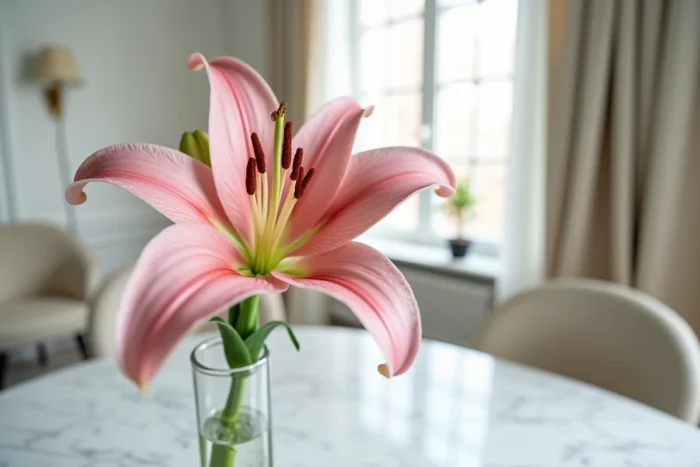
Pincing the lily stamens without damaging the flower
The technique is as important as the timing. One does not cut the stamens with scissors. Gently pinching the anther between two fingers or with a tissue remains the safest method. Scissors risk damaging the adjacent petal or cutting the filament too low, leaving a visible mark at the center of the corolla.
The right moment to intervene
The lily pollen is not yet volatile when the bud has just opened. The anthers are still moist, slightly sticky. This is the ideal window to remove them cleanly, without dispersing orange powder around the flower.
If one waits too long, the anthers dry out and the pollen detaches at the slightest draft. At this stage, every handling projects particles onto the white or pink petals. Opinions vary on this point, but most florists recommend acting within the first hours following the complete opening of the bud.
Checklist for clean removal
- Use a dry paper tissue or thin gloves to grasp each anther between the thumb and index finger, then gently pull upwards
- Never rub a stained petal: pollen embeds itself in the fibers upon contact with moisture, whether on a fabric or on the flower itself
- Check every day for new buds opening in the bouquet and remove the anthers as they appear
- Wash hands immediately after, especially if handling imported lilies that may carry treatment residues
Lily pollen stain on clothing: the saving reflex
Despite all precautions, a grain of pollen may land on a shirt or tablecloth. The first reflex, rubbing with a damp cloth, is precisely the one to avoid. Water sets the pollen pigment in the fibers of the fabric.
The most reliable method is to apply a piece of adhesive tape to the stain, then remove the tape with a firm motion. Repeat the process with clean pieces until most of the pollen is lifted. The speed of intervention makes the difference between a stain that disappears and a permanent mark.
On a lily petal, the principle is the same: do not rub. Lightly blow or tap with a dry brush to dislodge the grains without crushing them.

Lily bouquet in interior decoration: composing without pollen
The lily remains a choice flower in floral decoration, provided one anticipates the pollen issue. Once the stamens are removed, the flower retains its spectacular shape, fragrance, and stem length, while becoming compatible with light tablecloths, lacquered furniture, or delicate fabrics.
Combining lilies with other flowers and foliage
Current trends in floral composition favor the addition of foliage and secondary flowers to create volume without relying solely on the lily. Eucalyptus branches, grasses, or small white flowers like gypsophila soften the imposing look of the lily and mask the center of the corolla once the stamens are removed.
This finishing work explains why a bouquet prepared by a florist looks more polished than a homemade assembly. The removal of the stamens, combined with well-chosen foliage, gives a neat composition where each element has its place.
Maintaining the bouquet after removing the stamens
- Change the water in the vase every two days to limit bacterial growth that accelerates wilting
- Recut the stems at an angle with each water change, which improves absorption
- Place the bouquet away from direct heat sources and fruit bowls, as ethylene accelerates the degradation of cut flowers
The lily, free of its stamens, remains a visually impactful flower in an interior. The removal action takes just a few seconds per flower and avoids hours of cleaning on textiles. It’s the kind of detail that transforms a hastily bought bouquet into a durable decorative piece without unpleasant surprises.