
Bacon bits are among the most commonly used charcuterie products in everyday cooking. Their composition, rich in proteins and fats, also makes them a breeding ground for bacterial growth as soon as the cold chain weakens or the expiration date approaches. Knowing how to assess the state of a package of bacon bits before using it is as much about common sense as it is about carefully reading the packaging.
Expiration Date, Minimum Durability Date, and Health Alerts: What the Date on the Package Doesn’t Tell You
The expiration date (DLC), preceded by the mention “to be consumed by,” is the only reliable reference for bacon bits. Unlike the minimum durability date (DDM) found on dry or sterilized products, the DLC applies to perishable goods and must not be exceeded.
A package of bacon bits with a still-valid date can nonetheless pose a risk. Product recalls organized by retailers (Lidl, Intermarché, Auchan have been affected) show that a product “within its DLC” can contain pathogenic bacteria such as Salmonella or Listeria.
Regularly checking the reviews published on the government website RappelConso remains a useful reflex, beyond just checking the date.
Knowing how to identify expired bacon bits and how to recognize them requires an approach that goes beyond merely reading the label.
Smell, Color, and Texture of Bacon Bits: Reliable Signs of Deterioration
The senses remain the best verification tool once the package is opened. Three criteria allow for a quick assessment of whether the bacon bits are still consumable.
- Smell: fresh bacon bits emit a slightly salty or smoky aroma. A sour, acidic, or distinctly unpleasant smell indicates ongoing bacterial proliferation. This sign alone is enough to discard the product.
- Color: the normal hue ranges from pale pink to deep pink depending on the cut and smoking. Gray, greenish, or brownish areas indicate advanced oxidation or microbial development.
- Texture: to the touch, bacon bits should remain firm and slightly moist. A slimy, sticky, or gooey film on the surface is a clear marker of deterioration, even if the smell still seems acceptable.
The presence of just one of these signals justifies not consuming the product. A slimy bacon bit cannot be salvaged by cooking, contrary to popular belief. Heat can destroy some bacteria, but not the toxins they have already produced.
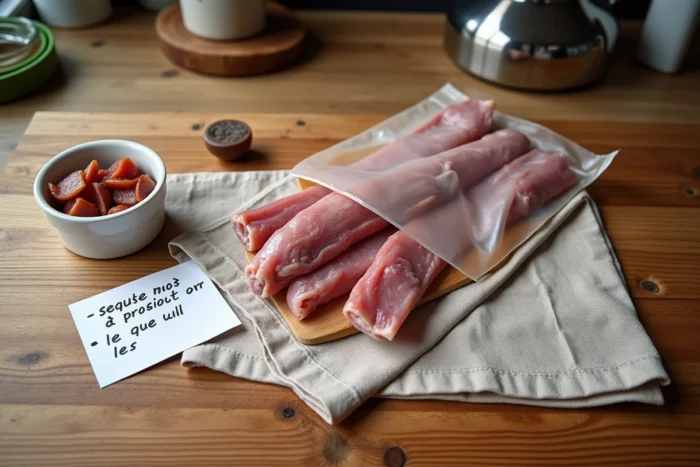
Bacterial Proliferation in Bacon Bits: Listeria and Salmonella
The two most monitored bacteria in charcuterie are Listeria monocytogenes and Salmonella. Their development in bacon bits accelerates as soon as the storage temperature exceeds a few degrees above the recommended range for refrigeration.
Listeriosis caused by Listeria monocytogenes can lead to serious complications, especially in pregnant women, the elderly, and immunocompromised individuals. Symptoms may appear several weeks after ingestion, complicating the identification of the food source.
Salmonellosis manifests more quickly, generally within hours or days following consumption. Diarrhea, fever, and abdominal cramps are the most common signs. In most cases, the episode resolves without specific treatment, but a medical consultation is necessary if symptoms persist or worsen.
These risks are not theoretical. Recalls of contaminated batches of bacon bits in large retail confirm that contamination can occur even before the package is opened.
Storage of Opened Bacon Bits: Duration and Real Conditions
An unopened package of bacon bits can be stored in the refrigerator until its DLC, provided that the temperature remains stable. Once the package is opened, the situation changes.
Bacon bits exposed to air degrade significantly faster. In practice, an opened package should be consumed quickly, ideally within days of opening. Transferring the remaining bacon bits to an airtight container or a well-sealed freezer bag limits contact with air and slows oxidation.
Freezing Bacon Bits: A Solution Under Conditions
Freezing bacon bits before their DLC extends their shelf life by several weeks. A few precautions are necessary:
- Freeze the product as soon as possible after purchase, not the day before the expiration date.
- Use an airtight bag, removing the air to avoid freezer burn.
- Thaw in the refrigerator, never at room temperature, to limit the window for bacterial proliferation.
- Never refreeze bacon bits that have already been thawed: breaking the cold chain multiplies the risks.
Bacon Bits and Long-Term Health: Beyond Freshness
Articles on expired bacon bits focus on the immediate risk of food poisoning. The question of regular consumption of charcuterie, including bacon bits, also deserves to be raised.
The National Agency for Food Safety (ANSES) recommends a gradual reduction in charcuterie consumption due to long-term risks, particularly of cancers and cardiovascular diseases. This recommendation applies not only to expired products but to overall habitual consumption.
Furthermore, an agreement in the charcuterie sector plans for a 5% reduction in salt and saturated fatty acids across a large portion of volumes by 2031, with bacon bits and belly among the targeted product families. However, no new regulatory or voluntary commitments have been made recently to reduce nitrites in bacon bits, despite repeated health alerts regarding these additives.
The freshness of a package of bacon bits does not summarize the entire health issue. A perfectly fresh product consumed daily raises other questions beyond those related to expiration. Adjusting the frequency of consumption and checking the composition on the label (salt content, presence of nitrites) usefully complements the reflex of checking the date and appearance of the product.