
Home equipment refers to the set of furniture, lighting, appliances, and functional objects that make up an interior. Choosing these elements is not just a matter of style: each piece affects circulation, thermal comfort, storage, and, since the AGEC law, the sustainability of what we buy. Setting the right criteria before furnishing helps avoid impulsive purchases that end up at the back of a garage.
Repairability and lifespan: criteria that design alone does not show
Since the implementation of the anti-waste law for a circular economy (AGEC), manufacturers of connected equipment must guarantee the availability of spare parts and inform about the repairability of each device. This regulatory framework changes the way to compare two seemingly identical products.
A connected light fixture or a smart thermostat now displays a duration for maintaining security updates. Ignoring this mention means buying equipment that will become obsolete long before it is physically worn out. For non-connected furniture, the reasoning remains the same: a sofa with a replaceable seat costs less over ten years than a glued and stapled model, even if sold at half price.
Before finalizing a purchase, checking three points is enough to filter out the majority of poor choices:
- The announced availability of spare parts (covers, motors, hinges, specific bulbs), ideally over several years.
- The presence of a repairability index for appliances and connected devices, made mandatory for certain product categories.
- The quality of assembly: a solid wood piece that is screwed together can be disassembled, repaired, and resold, unlike a glued melamine panel.
Choosing home equipment with iDéco Maison allows for comparing these technical characteristics across a wide catalog, from living room furniture to kitchen appliances.

Materials and colors: building visual coherence room by room
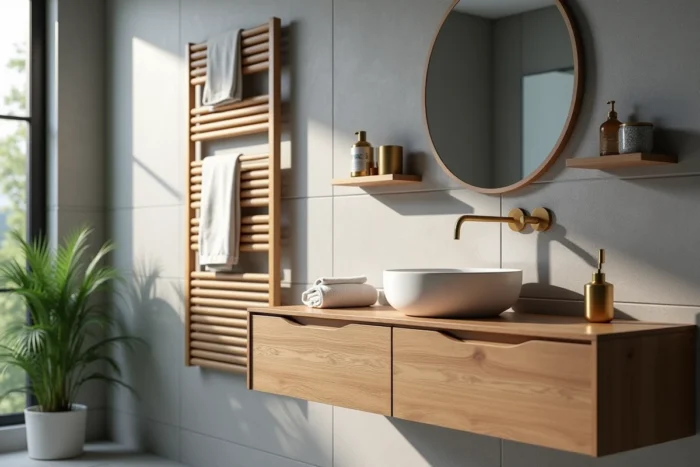
A stylish interior relies less on the quantity of furniture than on the coherence of materials and colors among them. Mixing light oak, brushed black metal, and waxed concrete works because these three finishes share a neutral palette. Adding a fourth, highly saturated material (red lacquer, yellow plastic) disrupts the whole without functional reason.
The simplest rule is to limit the palette to three dominant materials per room. Wood adds warmth, metal structures the lines, and textiles (linen, cotton, velvet) soften the volumes. Each additional item must meet a specific need, not a fleeting decorative desire.
Adapting colors to natural light
A north-facing room receives cold, diffuse light. Placing anthracite gray furniture and pure white walls creates a dull atmosphere. Warm tones on textiles (ochre, terracotta, sandy beige) compensate for the lack of direct light without repainting the walls.
Conversely, a south-facing room can support cool colors and raw materials (concrete, stone, light metal) that absorb visual heat. The choice of colors is not a matter of trend: it is a technical response to the orientation and volume of each space.
Layout by living area: thinking based on actual uses
Competitors systematically divide by room (kitchen, living room, bedroom). This logic misses a point: in most recent homes, living spaces are open. Reasoning by usage zone rather than by room results in a more functional layout.
A work zone can coexist with the living room if the desk has independent lighting and closed storage. An integrated dining area in the kitchen works as long as the table is sized for the actual number of daily diners, not for exceptional dinners.
The trap of oversized furniture
A large corner sofa in a modestly sized living room blocks circulation and prevents any reconfiguration. Before choosing a bulky piece, marking its actual dimensions on the floor with tape gives a reliable idea of the space it will occupy. Leaving a passage of at least 60 centimeters around the seating remains the reference for moving around comfortably.
The same reasoning applies to storage. A two-meter-wide sideboard fills a wall, but a series of modular shelves occupies the same linear space while adapting if the configuration changes. Modularity may cost a bit more at purchase, but it avoids having to replace an entire piece of furniture at the next move or rearrangement.
Connected equipment: how support duration changes the choice
Since 2023, every connected device sold in France must clearly indicate the duration for which it will be kept updated in terms of security. Connected lighting, thermostats, voice assistants, and smart appliances are affected.
This mention transforms the choice criterion. Two connected bulbs at the same price may have very different support durations. The one whose updates stop after two years exposes the home network to vulnerabilities, in addition to gradually losing its functionalities. Checking this information on the product sheet before purchase avoids ending up with a technically abandoned item.
For the rest of the non-connected appliances (refrigerator, cooktops, oven), the AGEC logic applies: the availability of spare parts determines the actual lifespan of the device. An oven whose heating element can be replaced in ten minutes lasts twice as long as a sealed model.
Equipping a functional and stylish interior relies on a constant trade-off between three variables: the technical durability of the product, its aesthetic coherence with the existing elements, and its adaptation to the actual uses of each living area. Recent regulations on repairability and software support add an objective filter that simplifies comparison, provided that product sheets are read beyond the photo.