
The fees of an interior decorator are not simply read as an hourly rate. The billing structure, the applicable VAT regime, and the exact scope of the mission condition a final budget that is often very different from the initial figure announced. Here, we decode the cost mechanisms that traditional pricing grids do not detail.
VAT on decoration fees: the item that no one budgets for
A renovated living room in a property completed more than two years ago can benefit from a reduced VAT rate on the work. However, the decorator’s fees remain subject to the normal VAT rate of 20%, regardless of the tax regime of the project. This discrepancy between the rate applied to supplies or installation and that which affects the intellectual service creates a budget gap that most quotes do not highlight.
Specifically, on a living room decoration project where the consulting service represents a significant portion of the total budget, this 20% VAT on fees increases the final bill. We recommend systematically requesting a detailed quote that separates the “consulting/decoration fees” line from the “work” line to anticipate this additional cost.
To compare offers in terms of price and ambiance with decoserotonine.fr, this distinction between billing lines is a prerequisite before any competition.
Interior decorator rates: reading a quote beyond the hourly rate
The average hourly rate of an interior decorator ranges from 50 to over 200 euros. This range, frequently cited, masks the operational reality of the profession. The billing method radically changes the final cost of a living room project.
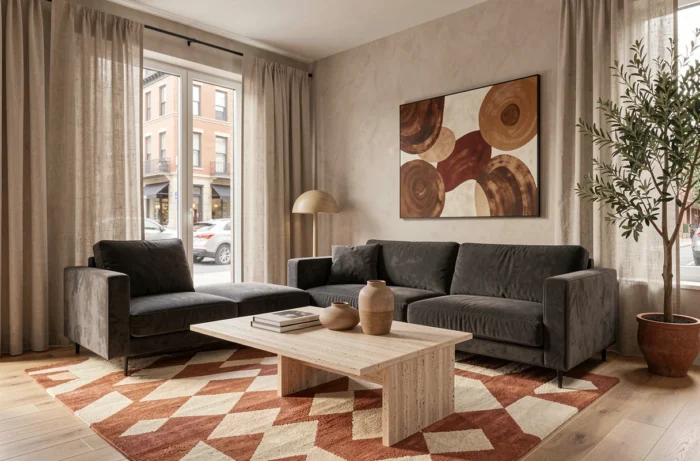
Flat fee per room or percentage on work
A decorator who charges a flat fee per room offers a fixed amount covering the consulting visit, layout plan, material board, and shopping list. This method is suitable for living room projects with a clearly defined scope (changing ambiance without altering partitioning).
Billing as a percentage of the total cost of the work (usually between 10 and 15%) applies more to projects that include project management or site supervision. For a living room alone, this pricing method can be more expensive if the furniture and materials budget is high.
Commission on purchases
Some decorators do not charge visible fees but earn through a commission on the furniture and supplies ordered through them. This model makes comparing quotes nearly impossible without asking for the details of the applied margins. A transparent decorator provides the list of suppliers and the catalog price of each item.
Living room decoration service: how the scope of the mission affects the budget
Not all decorators offer the same level of intervention. The cost varies less based on “talent” than on the contractual deliverable.
- The consulting visit (one to two hours on-site) results in oral recommendations or a short document. It constitutes the first level of intervention, suitable for a living room where the owner wishes to validate choices already outlined.
- The complete study includes measurements, mood board, furniture layout plan, color palette, and sourced shopping list. This is the most common service for truly transforming the atmosphere of a living room.
- The follow-up adds coordination of craftsmen, bulk orders, and compliance checks upon delivery. This level of mission brings the decorator closer to the role of interior architect, with a proportional fee.
We observe that the majority of living room projects fall into the second level. The first is too light for a significant ambiance change, while the third is only justified if secondary work accompanies the decoration (reworking recessed lighting, modifying technical wall coverings).
Choosing a decorator for your living room: contractual criteria to check before signing
The quote from a decorator is not just a commercial document. It legally binds both parties and must comply with specific obligations.

Recourse to a consumer mediator is mandatory for the professional and free for the client. The mediator’s contact details must appear on the quote or on the decorator’s website. The absence of this mention indicates a lack of regulatory compliance that should raise concerns even before discussing rates.
- Check that the quote mentions the details of the deliverables (number of boards, format of plans, number of site visits).
- Ensure that the validity period of the quote is indicated, as well as the conditions for price revision in case of delays attributable to the client.
- Ask if the decorator has professional liability insurance covering design advice.
The boundary between decorator and interior architect blurs on the ground. Only a qualified interior architect can intervene on the building’s structure. If your living room project involves opening a load-bearing wall or modifying a technical network, the decorator is not the right contact, regardless of their rate.
The actual cost of an interior decorator for a living room is therefore built on three parameters rarely aligned in a single grid: the chosen billing method, the level of service contracted, and the applicable tax regime. A well-structured quote, with separate lines and complete legal mentions, remains the only reliable tool for comparing offers that, on the surface, display comparable rates.