A pole saw is not chosen like a chainsaw. The weight-to-power ratio, the length of the guide, the type of motorization, and especially the working height all condition both cutting efficiency and operator safety. Here we review the technical criteria that make a difference in the field.
Weight-to-Power Ratio of a Pole Saw: The Criterion Often Underestimated in Comparisons
On a top handle pole saw used at height, every gram counts. The arm tires, the wrist compensates, and cutting precision deteriorates over the hours. A mid-range gas model weighs significantly more than a recent battery model but develops greater torque on hardwoods.
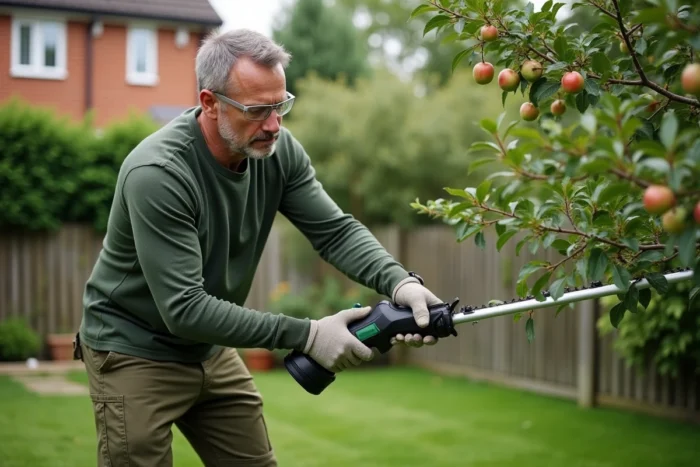
The current trend is leaning towards very lightweight cordless mini pole saws, sometimes below 1.5 kg including the battery. These machines are suitable for fine maintenance, small diameter branches, and cleaning fruit trees. Their brushless motor reduces vibrations and prolongs mechanical lifespan.
We recommend testing the model in hand before any purchase. An online catalog like elagueuse-warrior.com allows you to compare technical specifications and identify the actual weight differences between gas, corded, and battery ranges.
For regular interventions on medium to large diameter branches, the compromise lies with low-displacement gas pole saws. Their torque remains superior to that of battery models of the same weight, which limits chain jamming situations during cutting.
Telescopic Pole Saw or Top Handle Pole Saw: The Working Height Cuts the Debate
Above three meters, a ladder combined with a traditional chainsaw exposes you to a major risk of falling and kickback. This observation, often absent from consumer guides, should guide the choice of tool as much as engine power or guide length.
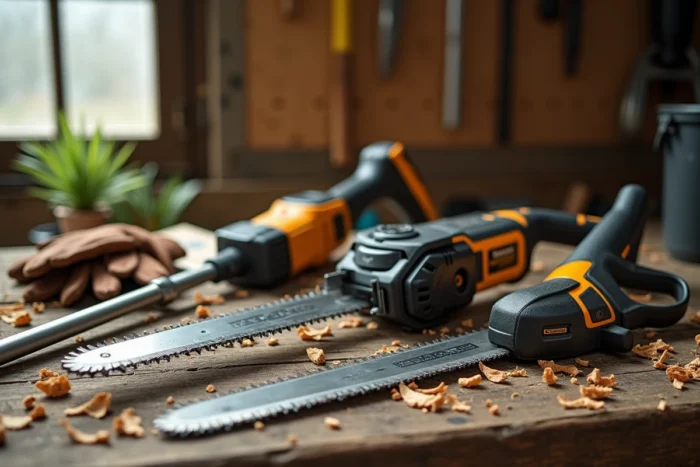
The telescopic pole saw allows you to reach high branches from the ground without climbing. Its telescopic length varies by model, with extensions that generally cover interventions up to five or six meters. The compromise: a higher total weight, reduced maneuverability, and lower cutting precision compared to a top handle used with a harness.
When to Favor the Top Handle
The top handle pole saw remains the reference tool for climbing arborists. Its compactness, one-handed grip, and short guide allow for precise cuts in dense canopies. However, its use on the ground is prohibited in France. This regulatory constraint clearly guides the choice: if you work exclusively from the ground, the top handle is not the suitable tool.
Gas Pole or Battery Pole
Gas poles offer unlimited autonomy as long as the tank is full, but their weight with arms extended tires quickly. Battery models are gaining ground due to reduced vibrations and instant starting. Battery compatibility with other tools in the same range becomes a relevant selection criterion: a single accumulator system for the pole, blower, and brushcutter reduces the overall equipment cost.
Guide Length and Chain Pitch: Adapting the Pole Saw to Branch Diameter
The length of the guide bar determines the maximum diameter of cut in a single pass. A guide that is too short forces you to redo the cut, which wears the chain and increases the risk of kickback. A guide that is too long on a lightweight machine destabilizes the whole and reduces maneuverability.
- For regular maintenance of fruit trees and shrubs (branches up to about 15 cm), a 25 cm guide is more than sufficient and maintains a good balance of the tool.
- For intermediate diameter branches on mature hardwoods, a 30 cm guide offers a compromise between versatility and maneuverability.
- Beyond a 35 cm guide, you enter the territory of felling chainsaws, not pole saws. If you need that length, the tool to choose is no longer the same.
The low-profile 3/8″ chain pitch is the standard on most pole saws. It combines a decent cutting speed with a low level of vibrations. Reduced pitch chains (1/4″) exist on some professional models for even finer work, but replacement links are harder to find.
Safety and Protective Equipment for Pruning
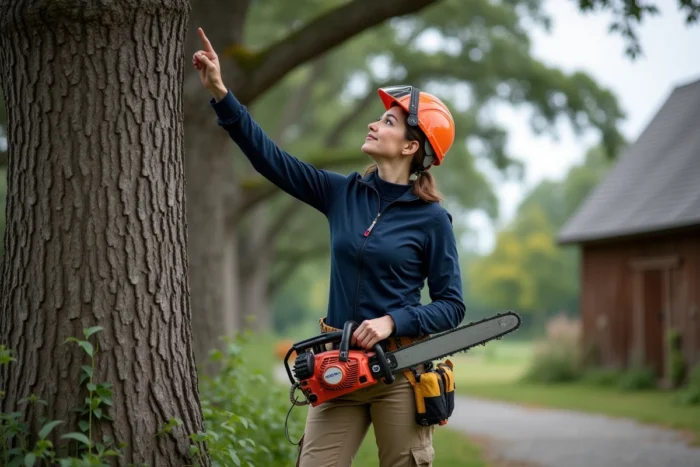
The pole saw is a fast cutting tool used in an unstable position. An inertial chain brake is a non-negotiable minimum: it stops the chain in case of kickback before the operator has time to react. Also check for the presence of an effective anti-vibration system, especially on gas models, to limit musculoskeletal disorders during prolonged use.
For the operator, the list of personal protective equipment is not limited to gloves:
- Cut-resistant pants (class 1 minimum for non-professional use, class 2 for regular arborists).
- Helmet with mesh visor and integrated hearing protection, even on battery models that remain noisy during cutting.
- Certified climbing harness if you work at height, with an anchor point independent of the branch you are cutting.
- Shoes or boots with cut-resistant protection on the top of the foot.
Automatic chain lubrication also contributes to safety: a poorly lubricated chain heats up, wears out prematurely, and increases the risk of breakage during cutting. Check the oil flow before each session and prefer biodegradable chain oil if you are working near waterways or sensitive areas.
Choosing a pole saw impacts both your work efficiency and your physical integrity. Take the time to consider the working height, branch diameter, and frequency of use before setting your budget. A well-sized model, maintained, and used with the appropriate protections remains the best investment for the health of your trees as well as your own.