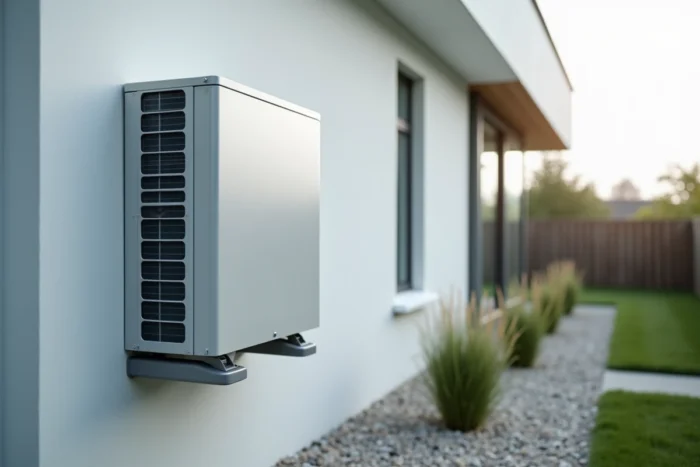
An air-to-water heat pump installed in a well-insulated house can cut heating bills by half, or even by two-thirds. On the ground, results vary greatly from one home to another. The ADEME/Enertech study conducted on 100 individual homes in France measured an average actual SCOP of 2.9, while manufacturer catalogs often display significantly higher values.
The gap between promise and reality rarely lies with the machine itself: it is determined by the settings, sizing, and choice of emitters.
Water supply temperature: the setting that most installations neglect
When addressing an underperforming air/water heat pump, the first parameter to check is the heating water supply temperature. Carrier recommends not exceeding 50 to 55 °C. Wolf specifies that a 5 °C decrease in the supply temperature measurably improves seasonal performance.
In practice, many installations are delivered with a heating curve set too high, sometimes as a precaution, sometimes because the emitters have not been properly adapted. This results in a heat pump operating at 60 or 65 °C to supply old high-temperature radiators, which reduces the COP to levels close to those of a conventional electric heating system.
To optimize heating through aerothermal energy, the priority is to lower this supply temperature as much as the emission system allows. This sometimes requires replacing a few undersized radiators or adding underfloor heating in the main rooms. The gain in efficiency more than compensates for the investment.
Water law, a parameter often misconfigured
The water law is the curve that automatically adjusts the supply temperature based on the outside temperature. A setting that is too conservative causes the heat pump to heat the water more than necessary during mild weather. Correcting this curve, sometimes by just a few degrees, significantly alters consumption over an entire season.
Low-temperature emitters and building envelope: what truly determines a heat pump’s efficiency
A high-performance heat pump depends as much on the building envelope and emitters as on the machine itself. Several reference sources converge on this point: without compatible low-temperature emitters, the heat pump cannot operate within its optimal efficiency range.
Underfloor heating is the ideal emitter. It operates with water at 30-35 °C, which maintains a high COP regardless of the season. Low-temperature radiators are a good alternative, provided they are properly sized for the area to be heated.
- Underfloor heating: lowest supply temperature, best seasonal efficiency, thermal inertia that smooths out restarts
- Low-temperature radiators: compatible with a heat pump if their exchange surface is sufficient for the required power of each room
- High-temperature radiators (older models): force the heat pump to exceed 55 °C, which severely degrades the COP
- Thermal insulation: reducing building heat loss decreases the required power and allows for operation at lower temperatures
Before changing to a more powerful heat pump, it is often beneficial to invest in attic insulation or window replacement. A high-performance envelope reduces power requirements and allows for lower temperature settings.
Hydraulic balancing: the invisible cause of underperformance
ADEME emphasizes that not all installations achieve their theoretical performance. Among the causes identified on-site, hydraulic balancing is a factor often underestimated by both installers and users.
A poorly balanced circuit distributes too much flow in some loops and not enough in others. The result: overheated rooms, others cold, and a heat pump that compensates by increasing its supply temperature. Overall efficiency drops without anyone understanding why.
Check flow rates before looking for a material failure
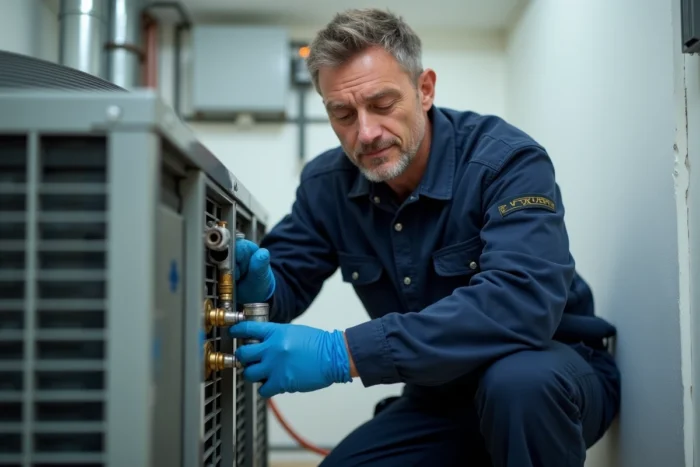
Field professionals now emphasize checking flow rates, system inertia, and control logic before considering component replacement. A simple rebalancing of the thermostatic valves or adjustment tees can be enough to restore the expected COP.
Feedback varies on this point depending on the complexity of the installation, but in a house with multiple circuits (mixed radiators and underfloor heating), hydraulic balancing should be systematic after commissioning.

Sizing the air-to-water heat pump: neither too much nor too little
Oversizing is as detrimental as undersizing. An oversized heat pump goes through short cycles, which wears out the compressor and degrades efficiency. An undersized heat pump constantly relies on its electric backup resistance, which skyrockets consumption.
The power calculation must be based on a thermal study of the building, not on a quick estimate of the living area. Actual heat losses depend on insulation, exposure, room volumes, and local climate.
- Preliminary thermal study: the only reliable way to determine the necessary power, taking into account solar gains and actual heat losses
- Choice of temperature regime: a heat pump sized to operate at a 35 °C supply will have a better SCOP than one calibrated for 55 °C
- Consideration of local climate: in Mediterranean areas, heating needs are very different from those in continental climates, which affects sizing and profitability
The average actual SCOP of 2.9 measured by the ADEME study shows that a third of installations could be more efficient. Proper sizing and fine-tuning matter more than the brand or price of the heat pump. A well-calibrated installation, with suitable emitters and careful hydraulic balancing, remains the best lever for benefiting from aerothermal energy in the long term.