Béatrice Vonderweidt, also known as Béatrice Goldnadel, is a French artist whose career spans modeling, photography, and painting. Her pictorial work, long discreet online, actually has concrete foundations: documented exhibitions, institutional recognition, and an acknowledged dialogue between photographic image and painted canvas.
Exhibitions of Béatrice Vonderweidt: a documented foundation in Tel Aviv
Most articles dedicated to Béatrice Vonderweidt claim that no exhibition or gallery is associated with her work. The facts tell a different story.
A collective exhibition titled “Regards croisés” was held at the French Institute in Tel Aviv in July 2008. It brought together paintings and photographs from four artists, including Béatrice Goldnadel. The setup mixed paintings and photographic images in an institutional framework linked to French cultural diplomacy in Israel.
A few years later, a solo exhibition called “Lumière et présences” was presented at the Caprice Gallery, located at 42 Frishman Street in Tel Aviv, in 2016. The gallery announced the event in a publication dated August 24, 2016.
These two events provide a precise geographical and institutional grounding for her practice. They also show that Béatrice Vonderweidt’s work is not limited to a private hobby but has been disseminated in identifiable venues.
An online gallery dedicated to photos and paintings by Béatrice Vonderweidt documents this journey by gathering visuals and biographical elements usually scattered across different platforms.
Painting and photography in Béatrice Vonderweidt’s work: two practices that respond to each other
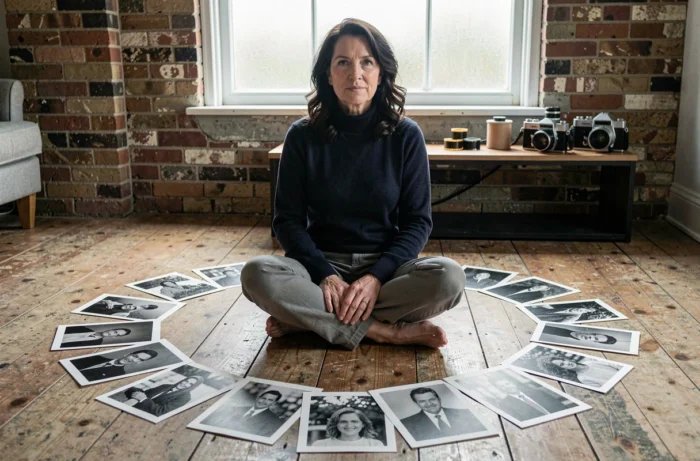
The term “artistic universe” takes on a concrete meaning when observing how painting and photography coexist in Béatrice Vonderweidt’s work. The 2008 exhibition “Regards croisés” did not juxtapose these two mediums by chance: her paintings engaged in dialogue with photographic images in the same space.
This approach is part of a tradition where the photographic nourishes the pictorial. The photo captures a moment, a light, a posture. The painting reinterprets this material by adding texture, subjective color, and free composition.
For Béatrice Vonderweidt, the transition from modeling to painting is not a rupture. It is a shift in perspective: from the photographed object (the body posing in front of the lens) to the painting subject (the artist who chooses what she shows and how). This shift explains why her canvases are often described as working with light and human presence, two concepts directly linked to photographic practice.
What the title “Lumière et présences” reveals about her approach
The choice of this title for her 2016 solo exhibition is not trivial. “Lumière” refers to photographic vocabulary, while “présences” pertains to the painted human figure. The two terms summarize the productive tension between her two practices.
A cultural publication linked to the French Embassy in Israel explicitly presents her as a “painter,” rather than as a former model turned artist. This institutional distinction matters: it recognizes an autonomous artistic practice, detached from a career in fashion.
Béatrice Vonderweidt as an artist: why so few traces online
Typing “Béatrice Vonderweidt photo” into a search engine yields no official portfolio, no structured personal website. The results are scattered between a Pinterest profile (craft and crochet boards under the name Beatrice Goldnadel Vonderweidt), genealogical records on Geneanet, and mentions in articles dedicated to her husband, lawyer Gilles-William Goldnadel.
This digital rarity does not reflect a lack of artistic production. It reflects a choice of discretion consistent with a career that favors physical galleries and institutional circles over algorithmic visibility.
Several factors explain this gap between public curiosity and low online presence:
- The absence of a personal website or account on dedicated artistic platforms (Artsy, Saatchi Art, Artmajeur) limits visibility in search results.
- The dual surname (Vonderweidt / Goldnadel) fragments digital presence: searches under one name do not retrieve results associated with the other.
- The documented exhibitions took place in Tel Aviv, within a limited Francophone media ecosystem, which reduces press coverage accessible from France.
An artist documented by others, not by herself
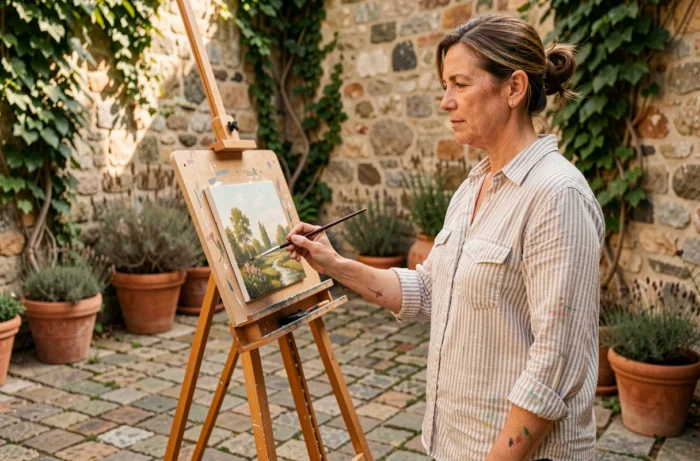
The information available about Béatrice Vonderweidt comes almost exclusively from third-party sources: a Facebook post from Magazine-economie discussing her journey “from modeling to painting,” gallery publications, and institutional mentions. She has not constructed a public narrative around her practice.
This positioning contrasts with the current norm, where most contemporary artists maintain an active presence on social media. It also makes online searches frustrating for those looking for visuals of her canvases or photographs of her exhibitions.
Modeling and pictorial creation: a path of artistic reinvention
The transition from modeling to painting is a path taken by several personalities, but it takes on a particular dimension for Béatrice Vonderweidt. Modeling relies on making one’s image available for the gaze of others. Painting reverses this relationship: the artist decides what will be seen and how.
This inversion of perspective is evident in the choice of subjects exhibited. The titles of her exhibitions (“Regards croisés,” “Lumière et présences”) systematically evoke the question of the visible and perception, as if the canvas extends a reflection begun in front of the lens.
The recognition by the French Institute in Tel Aviv and by the Caprice Gallery confirms that this reinvention is not merely a biographical anecdote. She has produced a body of work solid enough to be exhibited in venues that select their artists based on professional criteria.
Béatrice Vonderweidt’s journey remains largely to be documented. The few verifiable anchor points (two exhibitions in Tel Aviv, one French institutional recognition, an established dialogue between painting and photography) outline a coherent artistic practice, marked by a discretion that, in a saturated digital landscape of self-promotion, may constitute her most readable signature.