
An online site for two years, with content published every week, yet fewer than ten visits per day. This scenario affects the majority of sites that have never worked on their SEO methodically. With the rollout of Google’s AI Overviews in France since July 2026, organic visibility now depends on more technical and demanding criteria than before.
Here are ten concrete actions to improve your website’s visibility, listed in no particular order. Each targets a specific lever, from source code to content strategy.
1. Structure your data to appear in Google’s AI responses

Since Google deployed AI Overviews and AI Mode in France on July 22, 2026, an increasing share of queries displays a synthetic answer above traditional results. For a site to be cited in these responses, it must provide structured data (schema.org markup) that facilitates the automatic extraction of information.
In practice, we start with the most strategic pages: product sheets, FAQs, blog articles. FAQ, HowTo, or Product markup allows algorithms to identify clear answers. Without structured data, a site becomes invisible to AI engines, even if it is well-positioned in traditional SEO.
2. Target long-tail queries with conversational keywords

We frequently find tips to increase the visibility of your website that emphasize generic keywords. The problem is that these short queries are saturated with competition and often captured by AI responses without generating clicks.
Long-tail queries, formulated as natural questions (“which craftsman to renovate a stone facade in Toulouse”), attract more qualified traffic. With the rise of voice search, these conversational formulations represent an underutilized lever. They can be identified via Google Search Console by filtering queries that generate impressions but few clicks.
3. Reduce loading time to under two seconds
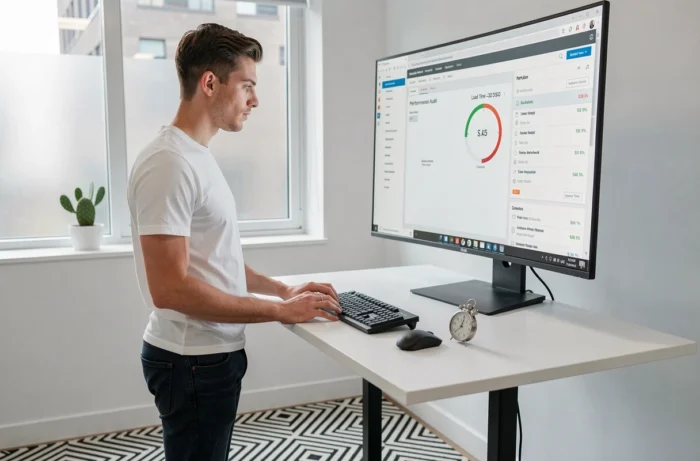
A slow site loses visitors before they even read the first line. Google’s Core Web Vitals measure three indicators: loading speed of the main content, responsiveness to interactions, and visual stability of the page.
The actions that have the most impact:
- Compress images in WebP format and serve them with lazy loading to defer their loading
- Minify CSS and JavaScript files by removing unused code
- Use a CDN (content delivery network) to reduce geographical latency
A one-second gain in loading time measurably improves the conversion rate. You can check your performance with PageSpeed Insights or GTmetrix.
4. Build an internal linking structure oriented towards user journey

Internal links are not just for SEO. They guide the visitor from one page to another according to a logic of need. We link a category page to its sub-pages, a blog article to a complementary product sheet.
A common trap: creating internal links en masse without thematic coherence. Google interprets these links as signals of relevance. If a page on renovation points to a page on accounting, the signal is muddled. Each internal link should answer a question that the visitor is asking at that moment.
5. Obtain backlinks from thematically related sites
A backlink from a general directory carries much less weight than a link from a blog specialized in your field. Google evaluates the thematic relevance of the source site, not just its overall authority.
These links can be obtained through editorial collaborations, cross-interviews, or publishing original data that other sites will want to cite. Returns vary on this point depending on sectors, but the constant remains the same: the quality of the referring domain outweighs quantity.
6. Adapt each page to a mobile-first format

Google now indexes sites primarily through their mobile version. A site that displays correctly on desktop but truncates its content on smartphone will be penalized in search results.
Each page is tested with Google’s mobile optimization testing tool. The most common errors include: buttons too small to be clicked with a finger, text overflowing the screen, pop-ups obscuring the main content. Fixing these issues takes a few hours, and the impact on SEO is immediate.
7. Write unique title tags and meta descriptions for each page
Each page of your site appears in search results with a title and description. If these tags are duplicated or generated automatically, the click-through rate drops. An effective title tag contains the main keyword and does not exceed 60 characters.
The meta description serves as a pitch. It should include a concrete benefit for the user, not a list of keywords. It is often the first contact between your site and a potential customer on Google.
8. Publish content that answers real search intents

A blog article that addresses a topic without answering the user’s specific question generates neither traffic nor engagement. Before writing, we analyze the intent behind the query: informational, transactional, or navigational.
The content must match what the user expects at the moment they type their query. For a search like “price tile installation per m2,” the user wants a figure, not a 2000-word article on the history of tiling. We adapt the format: comparison table, direct answer in the introduction, short paragraphs.
9. Create a complete and up-to-date Google Business Profile
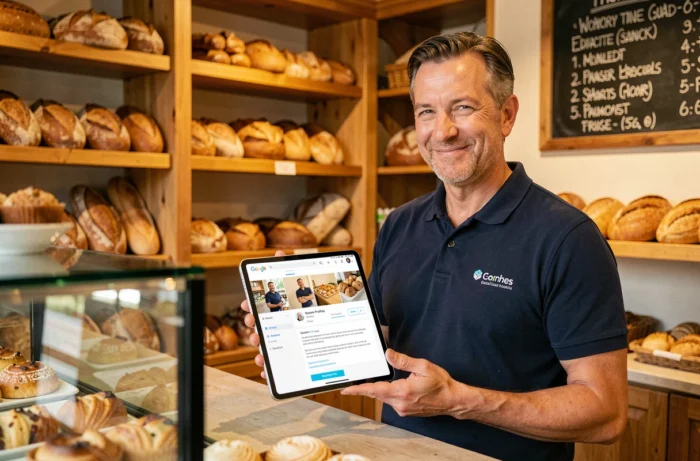
For any business with a local catchment area, the Google Business Profile is a major visibility lever. It appears in the local pack (the three results with a map) and on Google Maps.
Fill in the address, hours, activity categories, and publish recent photos. Customer reviews play a direct role in local ranking. Responding to each review, positive or negative, sends a signal of activity to Google’s algorithms.
10. Monitor your positions and adjust your strategy each month
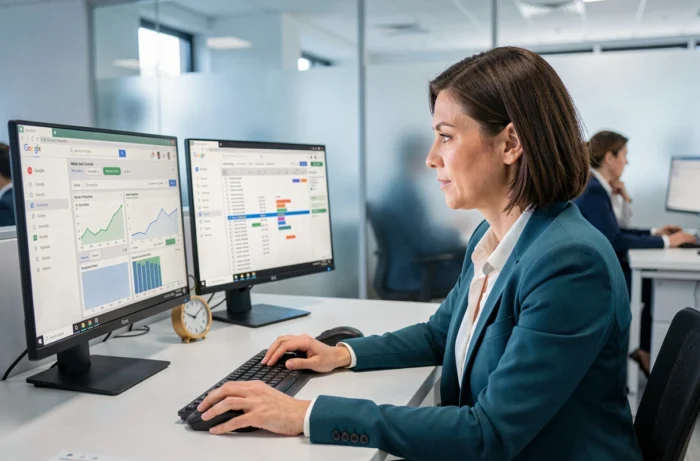
Implementing the previous nine actions without monitoring is like navigating without a compass. Google Search Console provides free performance data: queries that generate impressions, click-through rates, average position per page.
Identify the pages that stagnate between positions 8 and 15 (those close to the first page) and focus efforts on them: enriching content, adding internal links, improving the title. Monthly monitoring allows you to detect a drop in visibility before it becomes critical.
In the United States, about 68% of Google searches ended without a click in early 2026, compared to about 60% in 2024. This trend is now affecting France with AI Overviews. Working on web visibility is no longer limited to positioning in traditional results: it is necessary to build a strong enough brand presence for users to click despite the direct answers generated by engines.