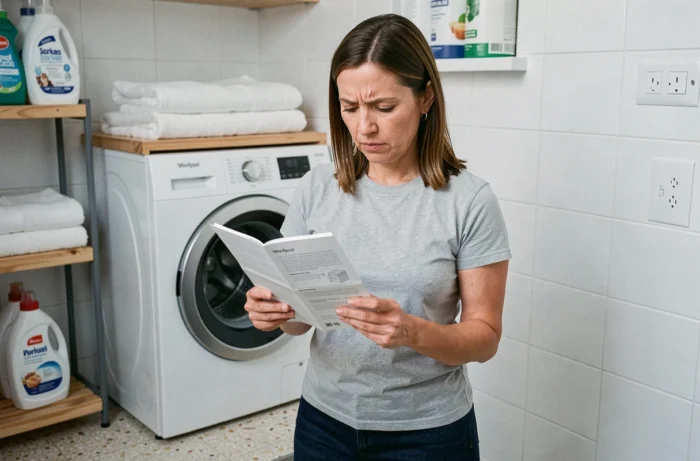
A Whirlpool 6th Sense 9 kg washing machine communicates via alphanumeric codes displayed on its control panel. Each code (F followed by a number, or two letters like FH or FP) indicates an anomaly detected by the internal sensors. Reading this code is not enough: the same indication can point to a loading issue, an installation defect, or a real electronic failure.
Differentiating these three origins helps avoid ordering unnecessary parts or calling a technician for a closed faucet.
Status lights and error codes Whirlpool: two signals not to confuse
Before diagnosing anything, it is essential to separate status lights from error codes. The 6th Sense 9 kg models display permanent icons during normal operation: door locked, FreshCare+, delayed start, key lock, ongoing cycle phase. These indications do not signal any anomaly.
An error code, on the other hand, interrupts the cycle and remains frozen on the screen. Confusing the two generates unnecessary service calls. If the door lock symbol lights up during the spin cycle, the machine is functioning normally. If the F03 code appears and the drum stops, there is a problem to investigate.
To find the precise correspondence between each icon and each code on the FFBP, FFSPL, or FFWDB series, the Whirlpool 6th Sense 9kg washing machine manual details these distinctions better than the manufacturer’s notice included in the box.
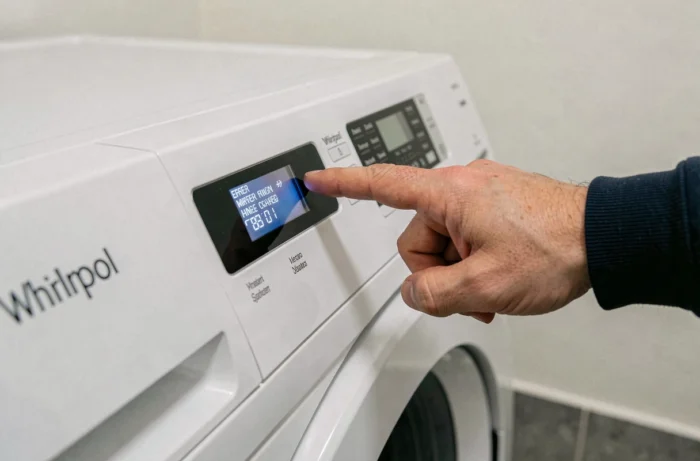
Clothes, installation, or electronic failure: identifying the true cause of an error code
Most online guides translate the codes one by one. This approach misses the central point: the same code can have three completely different origins. Classifying the problem by source before looking for the faulty part saves time and money.
Origin related to laundry or loading
An overloaded drum or highly absorbent textiles (duvet, bath mat) can cause an imbalance detected by the 6th Sense technology. The machine attempts to rebalance the load, fails, and displays a code related to the motor (F06) or draining (F03/FP) because the cycle cannot finish normally.
- Removing some laundry, redistributing the rest in the drum, and restarting a short cycle can help check if the code disappears
- Textiles that swell when absorbing water (synthetic duvets, thick throws) often exceed the useful capacity even if the drum seemed half-empty at loading
- An excess of detergent produces too much foam, which disrupts the water level sensors and can trigger a F01/FH code without any water supply issue
Origin related to installation
The F01/FH code indicates a water supply issue. Before suspecting the solenoid valve, check that the supply faucet is open and that the inlet hose is not bent or crushed behind the machine.
The F03/FP code (draining) also appears when the drainage hose plunges too deeply into the siphon or forms a tight bend.
A clogged drain filter is the most common cause of the F03 code. Cleaning it takes less than five minutes and requires no tools. The manual mentions this maintenance task, but rarely with enough emphasis for it to be done regularly.
Actual electronic origin
If the code persists after checking the laundry and installation, the failure is likely on the component side. Here are the most common associations on the Whirlpool 9 kg 6th Sense:
- F01/FH after checking the faucet and hose: defective water inlet solenoid valve
- F02/FA: the Aquastop system has detected a leak, check the drip tray under the machine
- F04: the heating element no longer heats up, often scaled or broken
- F05: temperature sensor (NTC) open circuit or short circuit
- F06 after excluding an imbalance: electronic board or motor brushes issue on models with a conventional motor
Whirlpool 6th Sense reset: the action to try before any disassembly
A brief power cut or a surge can cause an error code to appear without any component being faulty. The resetting of the electronic board is the first action to attempt, yet the official manual for the 9 kg series barely details it.
The procedure involves unplugging the machine from the power outlet, waiting several minutes, then plugging it back in and starting a short empty cycle. This delay allows the capacitors on the board to discharge completely. If the code reappears as soon as the cycle restarts, the problem is not an electrical artifact: the indicated component needs investigation.
When to note the context of the code’s appearance
The moment the code appears provides valuable information. An F04 that appears after a few minutes of the cycle points to a heating element or its connection. An F03 that only occurs at the end of the spin cycle indicates the drain pump or filter. Noting the phase of the cycle helps the technician diagnose more quickly if a professional intervention is deemed necessary.
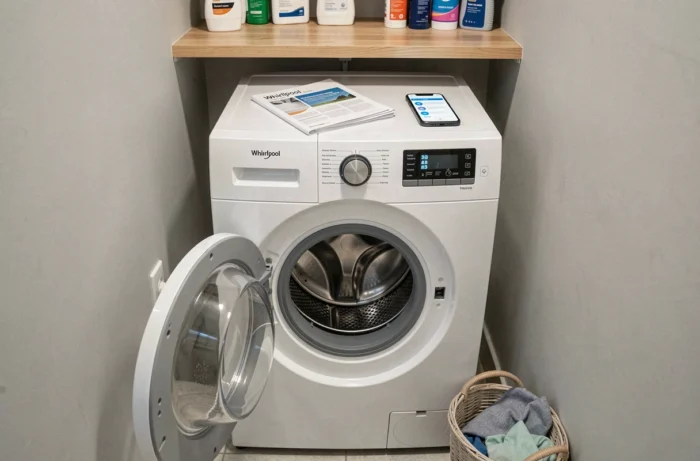
Electronic board and heating element: recurring failures of the Whirlpool 9 kg
Two components account for the majority of technical interventions on these models. The electronic board (power module) is sensitive to power surges. A surge protector on the power outlet reduces this risk. When the board fails, several codes may display simultaneously or alternate inconsistently, distinguishing it from an isolated sensor failure.
The heating element, associated with the F04 code, gradually scales in areas where the water is hard. A monthly high-temperature cleaning cycle (without laundry, with a descaler) extends its lifespan. Replacing a scaled heating element is cheaper than replacing the board, hence the importance of not ignoring an intermittent F04.
When an error code persists after resetting, checking the installation, and cleaning the filter, the indicated component is likely at fault. At this stage, noting the exact code, the phase of the cycle, and the drum behavior before contacting a repair technician allows for a quicker diagnosis and avoids unnecessary trips.