
You fill out an online payment form, and the site asks you to enter “MM/YY”. Two fields, four digits, and yet this code regularly causes hesitation. MM/YY refers to the expiration date of your credit card, expressed in month and then year. It’s a simple piece of information, but its role in the payment chain goes beyond a mere data entry formality.
Expired card and contactless payment: a real vulnerability
Competitors treat the MM/YY date as an absolute lock. The technical reality is more nuanced. Cybersecurity researchers have demonstrated that a physically expired Visa card can still be used for contactless payments.
The expiration date is transmitted as a simple compliance data point in the NFC protocol. During targeted attacks, this data can be altered in transit before reaching the terminal. The terminal then validates the transaction as if the card were still active.
For cardholders, the practical consequence is clear: an expired card is not automatically deactivated. When you receive your new card, do not throw the old one in the trash without precautions. Cut up the chip and the magnetic strip before disposing of it.
Another case deserves attention. When a card is stored in a digital wallet (Apple Pay, Google Pay), the security certificate of the wallet may have a different lifespan than the MM/YY date printed on the plastic. In practice, this means that a mobile payment can work after the physical card has expired, as long as the wallet’s certificate remains valid.
If you want to understand the mm yy code on a credit card in detail, this distinction between the visible date and the actual validity date is often overlooked.

MM/YY during an online purchase: what the system really checks
When you enter your expiration date on a merchant site, this information is not verified alone. It is part of a set of data transmitted to the banking network.
Here’s what the system checks simultaneously:
- The sixteen-digit card number, which identifies your account and issuing bank.
- The MM/YY date, which confirms that the card is valid according to the issuer’s records.
- The CVV code (the three digits on the back), which proves that you physically have the card in hand.
- Strong authentication (3D Secure, validation via banking app), which confirms your identity as the cardholder.
The expiration date alone is never enough to authorize a payment. If a fraudster only has the card number and the MM/YY date, the CVV and strong authentication block the transaction in most cases.
Have you ever seen your payment declined while your card is valid? The most common mistake is mixing up the month and year. If your card expires in March 2027, the field expects “03/27” and not “27/03”. Some forms display MM/YYYY (with the year in four digits), while others show MM/YY (two digits). Always check the format requested by the site before typing.
Credit card renewal: what changes for your subscriptions
Your card expires on the last day of the indicated month. A card showing 09/26 remains usable until September 30, 2026, inclusive. On October 1, it will no longer work.
Most banks send the new card a few weeks before the expiration date. But receiving the new plastic is not enough. Every subscription registered with the old card must be manually updated.
The services involved are numerous:
- Streaming platforms (the new number and date are required).
- Insurance and mutuals charged by card.
- Transport subscriptions, cloud storage, software licenses.
Some networks (Visa, Mastercard) offer an automatic card data update system with partner merchants. This mechanism does not cover all merchants. If a payment fails after renewal, check your banking details on the service’s website before contacting your bank.
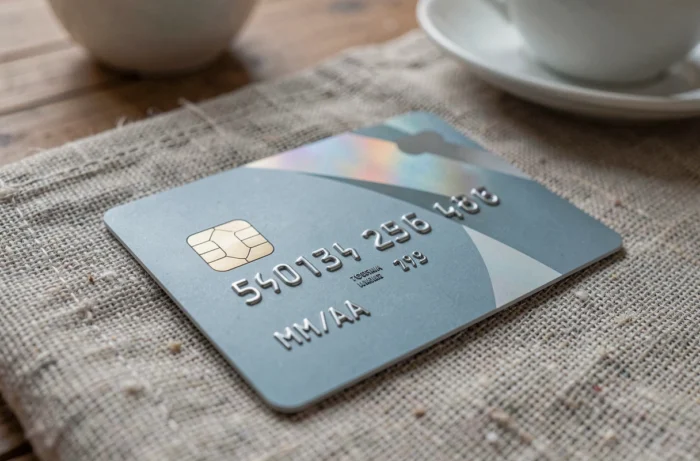
Protecting the MM/YY date and CVV in daily life
The expiration date is clearly displayed on the front of the card. Anyone who photographs or memorizes the front and back has the number, date, and CVV. These three elements are enough to attempt a purchase on a site without strong authentication.
Concrete actions to limit risks
Never share your expiration date over the phone or by email, even with someone claiming to be your bank. No bank advisor will ask you for your CVV or MM/YY date. Such requests are a clear sign of a fraud attempt.
When making a payment in-store, keep your card in your line of sight. A server who takes your card out of your view has time to note the information needed for a fraudulent online purchase.
For online purchases, prefer virtual single-use cards offered by most online banks. These cards generate a temporary number, MM/YY date, and CVV, valid for a single transaction. Even if this data is intercepted, it becomes unusable after the purchase.
The MM/YY date remains a link in the banking security chain, not a standalone lock. Its true utility lies in its combination with other authentication elements. Keeping this reflex in mind significantly reduces the risk of fraud on your payments.